
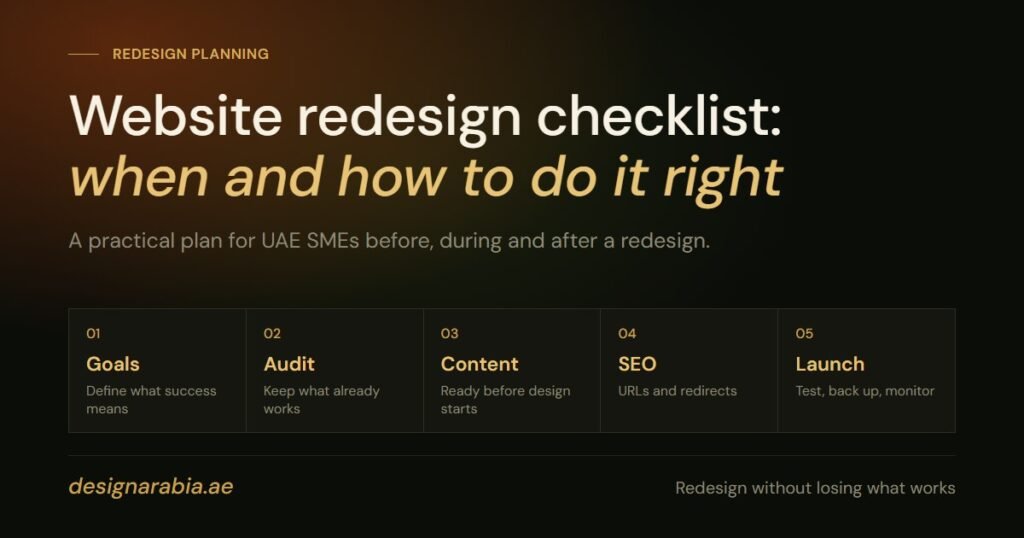
A website redesign can help UAE SMEs turn an outdated site into a clearer, faster, and more useful business tool. For companies in Dubai, Sharjah, and Abu Dhabi, the goal is not simply to change the look of the website, but to improve enquiries, trust, navigation, content, and search visibility. This guide explains when to redesign your website, what to include in your website redesign checklist, and how to manage the website redesign process without losing focus on business results.
When should UAE SMEs redesign their website?
You should redesign your website when it no longer supports how your business sells, communicates, or competes online. If customers cannot quickly understand what you offer, find key information, or contact you, the website is creating friction instead of helping growth. For UAE businesses, this can directly affect lead generation, especially in competitive markets such as real estate, clinics, professional services, construction, education, hospitality, and e-commerce.
A redesign is also worth considering when your business has changed. Maybe you have opened a new branch in Abu Dhabi, expanded services in Dubai, started serving B2B clients in Sharjah, or shifted from basic enquiries to online bookings. If your current site still reflects the old version of your company, visitors may leave before they see your value.
Clear signs that a website redesign is needed
Many business owners wait until a website looks outdated before they plan a website revamp. Visual design matters, but it is only one signal. A website may look acceptable and still perform poorly if it is slow, confusing, hard to update, or not built around the customer journey.
Here are practical signs that a redesign may be needed:
- Your website does not generate enough enquiries. If traffic is coming in but calls, form submissions, WhatsApp clicks, or booking requests are low, the site may not be guiding visitors clearly.
- The design feels dated compared with your competitors. UAE customers often compare options quickly. If your site feels old or unclear, it can weaken trust before a conversation begins.
- Mobile users struggle. Many visitors in the UAE browse from phones. If text is too small, buttons are hard to tap, forms are long, or pages load slowly, you may lose potential customers.
- Your services, prices, locations, or team have changed. A site that no longer reflects your current business can confuse visitors and create mismatched enquiries.
- You cannot update content easily. If every small change requires technical help, your marketing team may avoid improving pages, adding offers, or publishing useful content.
- Search rankings have dropped. Weak page structure, outdated content, poor speed, and missing SEO basics can affect visibility.
- The site does not match your brand anymore. If your company has grown, improved, or changed direction, your website should support that positioning.
- Customers keep asking basic questions. If people call to ask where you are located, what you do, or how to request a quote, your website content may not be clear enough.
- Your website lacks trust signals. For UAE SMEs, items such as location details, service areas, company information, case examples, certifications, client sectors, and clear contact options can help visitors feel more confident.
A redesign is not always a full rebuild. In some cases, a focused website revamp may be enough, such as improving key service pages, simplifying forms, or updating mobile layouts. In other cases, the website structure, platform, content, and SEO setup may need a deeper rebuild.
A practical website redesign checklist for UAE businesses
A useful website redesign checklist should cover strategy, content, design, SEO, testing, and launch planning. Skipping any of these areas can lead to a site that looks new but still has the same business problems. Before you brief a designer or developer, clarify what success should look like.
Use this checklist as a starting point:
- Define the business goal. Decide whether the redesign should increase enquiries, improve credibility, support recruitment, grow online sales, explain complex services, or help visitors book consultations.
- Review current website performance. Look at traffic, enquiry sources, popular pages, weak pages, search rankings, form submissions, bounce rates, and common customer questions.
- Identify your core audiences. A Dubai clinic, a Sharjah manufacturing company, and an Abu Dhabi consultancy may all need different content and conversion paths.
- Map key pages. List the pages your new site needs, such as home, about, services, industries, locations, case studies, blog, contact, and landing pages.
- Plan conversion actions. Decide where to use call buttons, WhatsApp links, forms, quote requests, appointment buttons, downloads, or map directions.
- Audit existing content. Keep useful pages, improve weak pages, merge duplicate content, and remove outdated information.
- Protect SEO value. Record current URLs, rankings, metadata, internal links, and backlinks before changing the site.
- Improve mobile experience. Check layouts, buttons, menus, page speed, forms, images, and readability on common phone screens.
- Prepare brand assets. Collect your logo files, brand colours, images, team photos, service details, brochures, and any updated messaging.
- Test before launch. Review forms, buttons, links, menus, payment steps if relevant, page speed, tracking, and SEO settings.
- Plan the website relaunch. Decide the launch date, backup plan, redirect plan, post-launch checks, and who approves final changes.
For a smoother project, keep the checklist practical. A long document that nobody uses is less helpful than a clear list owned by your team, your developer, and your marketing partner.
What should the website redesign process include?
The website redesign process should include discovery, planning, content, design, development, SEO preparation, testing, launch, and post-launch improvement. Each stage reduces risk and helps the final website support real business goals rather than only visual preferences. When these stages are rushed, common problems appear later, such as missing pages, broken links, slow performance, or unclear messaging.
Discovery and goals
Start by asking what the current site is failing to do. Is it not bringing enough enquiries from Dubai? Are Abu Dhabi customers struggling to understand your service areas? Are Sharjah clients asking for information that should already be on the site? These questions help you focus the redesign around user needs and business value.
At this stage, gather input from sales, customer service, management, and marketing. Sales teams often know which questions prospects ask before buying. Customer service teams know where confusion happens. Marketing teams can share which campaigns, keywords, or landing pages need stronger support.
Site structure and user journey
A strong structure helps visitors move from interest to action. Your menu should be simple, your service pages should be easy to find, and your contact options should be visible without feeling pushy. If you serve multiple emirates, consider whether location pages or location references are useful, but only create pages when they offer real information.
Think about the path a visitor takes. Someone comparing suppliers may need service details, proof of experience, sectors served, and an easy enquiry form. Someone ready to call may need a phone number, WhatsApp button, map, and opening hours. A good redesign supports both types of visitors.
Content and messaging
Content is where many redesign projects slow down. A new layout will not fix vague service descriptions or unclear offers. Before design begins, write or improve the copy for important pages so the design can support the message.
For UAE SMEs, plain content often works better than overcomplicated wording. Explain what you do, who you help, where you work, how the process works, and what the visitor should do next. If you work across Dubai, Sharjah, and Abu Dhabi, mention this naturally where relevant rather than repeating locations in every paragraph.
Design and development
Design should make information easier to understand. Clear headings, readable text, strong contrast, simple menus, and visible calls to action are more important than decorative effects. A polished website can still fail if visitors cannot find the answer they came for.
Development turns the approved design into a working site. If you need a flexible content management system, WordPress may be suitable for many SME websites. You can explore Design Arabia’s WordPress development service if your team needs a site that is easier to manage after launch.
Website redesign SEO needs early planning
Website redesign SEO should begin before pages are deleted, renamed, merged, or moved. Many businesses only think about SEO after launch, when rankings or traffic have already dropped. A careful plan helps protect existing visibility while giving the new site a stronger foundation.
Before the redesign, review your current search performance. Identify which pages bring organic traffic, which keywords attract relevant visitors, and which pages have links from other websites. These pages need special care during the redesign because losing them without a plan can reduce enquiries.
Important SEO actions include:
- Keep valuable URLs where possible. If a page already performs well and the URL still makes sense, avoid changing it without a reason.
- Use redirects for changed URLs. When a page address changes, a redirect helps visitors and search engines find the new version.
- Improve page titles and descriptions. Each important page should clearly describe its topic and value, as explained in our guide to title tags and meta descriptions.
- Use clear headings. Headings help visitors scan the page and understand the structure.
- Avoid duplicate service pages. Creating many near-identical pages for different locations can make the site weaker. Add location detail only when it is useful and specific.
- Compress images. Large image files can slow down mobile browsing, which affects user experience.
- Check internal links. Important pages should link to each other in a natural way, helping users move through the site.
- Set up tracking. Make sure analytics, form tracking, call tracking, or other measurement tools work after launch.
SEO is not just about rankings. It is also about matching pages to the questions your customers actually ask. A service page should help the visitor understand the service, decide whether it fits their needs, and take the next step.
Budget, timing, and scope need clear decisions
A website redesign can range from a light refresh to a full rebuild. The right scope depends on your current site, business goals, content needs, integrations, platform, and the number of pages. A small brochure site will require a different plan from a multilingual corporate website, an e-commerce store, or a lead generation site with many service pages.
Before requesting quotes, decide what is included and what is not. This prevents confusion later and helps you compare proposals fairly. For example, one quote may include copywriting, SEO migration, mobile testing, and post-launch support, while another may only include design and basic development.
Key cost factors often include:
- Number of pages and templates
- Custom design requirements
- Copywriting or content editing
- SEO audit and redirect planning
- Photography, graphics, or video support
- Booking forms, payment features, CRM links, or other integrations
- Multilingual setup, if needed
- Hosting, maintenance, and security support
If you are planning your budget, Design Arabia’s website cost guide can help you understand the types of factors that influence website pricing in Dubai and across the UAE. The goal is not to choose the cheapest option automatically, but to understand what you are paying for and whether it supports your business needs.
Common redesign mistakes to avoid
Many website redesign problems come from focusing too much on appearance and too little on planning. A modern look is useful, but it should support clear communication, faster action, and better measurement. Avoid treating the redesign as a design task only.
One common mistake is deleting old pages without checking whether they bring traffic or leads. Another is launching a new design with thin content, unclear headings, or missing contact details. Some businesses also forget to test forms, WhatsApp links, map links, and mobile menus before launch, which can create lost enquiries during the first few days.
Watch out for these issues:
- Redesigning without clear goals
- Copying competitor layouts without understanding your own customers
- Using large images that slow down mobile pages
- Hiding phone numbers or enquiry buttons
- Making forms too long
- Ignoring Arabic or multilingual needs if your audience requires them
- Launching without redirects
- Forgetting analytics and conversion tracking
- Approving designs before content is ready
- Adding too many animations or effects that distract from the message
A good redesign should feel simple for visitors and manageable for your team. If the new site is hard to update, difficult to measure, or confusing for customers, the project has not solved enough of the original problems.
A simple pre-launch checklist
The website relaunch is the point where planning becomes visible to customers, search engines, and your internal team. Treat it as a controlled process rather than a quick switch. Even a small business website should be checked carefully before going live.
Use this pre-launch checklist, and see our full website launch checklist for the 30 detailed checks:
- Test every main page on desktop and mobile.
- Submit all forms and confirm messages are received.
- Check phone numbers, email links, WhatsApp links, and map links.
- Review spelling, service descriptions, company details, and location information.
- Confirm page titles, meta descriptions, headings, and image alt text are added where needed.
- Check redirects from old URLs to new URLs.
- Make sure analytics and conversion tracking are installed.
- Test page loading speed and reduce large files where possible.
- Review privacy policy, terms, and cookie notices if they apply to your business.
- Create a backup before launch.
- Ask a few people outside the project to browse the site and report anything confusing.
After launch, continue checking the site for at least a few weeks, and consider a website maintenance plan to keep it secure and updated. Look for broken links, changes in traffic, form issues, ranking movement, and user behaviour. A redesign should not stop at launch. It should lead into regular improvement.
How to choose the right redesign partner in the UAE
The right partner should understand both the technical side of websites and the commercial reality of UAE SMEs. You need a team that can ask about your business goals, customer journey, content, SEO, and launch plan, not only colours and layouts. This matters whether you operate in Dubai, Sharjah, Abu Dhabi, or across the wider UAE.
When speaking with a redesign agency or developer, ask practical questions. How will they protect current SEO value? Who writes or edits the content? How will mobile testing be handled? What happens after launch if forms fail or changes are needed? Clear answers at the start can prevent delays and misunderstandings later.
It is also useful to ask what your team will be able to update after launch. If your marketing manager needs to add blog posts, update services, publish landing pages, or change banners, the website should support that. A beautiful site that depends on a developer for every minor edit can slow down your marketing.
If you want a guided approach, Design Arabia offers website redesign services for UAE businesses that need clearer structure, improved design, better usability, and a more planned relaunch.
Final takeaway
A website redesign is a business decision, not only a creative project. For SMEs in Dubai, Sharjah, and Abu Dhabi, the right approach starts with clear goals, honest review of the current site, practical content, mobile-friendly design, SEO protection, and careful launch testing. Use this website redesign checklist to decide what needs to change, what should be protected, and what your new website must help customers do.
If your current website is outdated, difficult to update, or not bringing the right enquiries, Design Arabia can help you plan the next step. Contact Design Arabia to discuss your website redesign and build a clearer path toward a stronger website relaunch.