
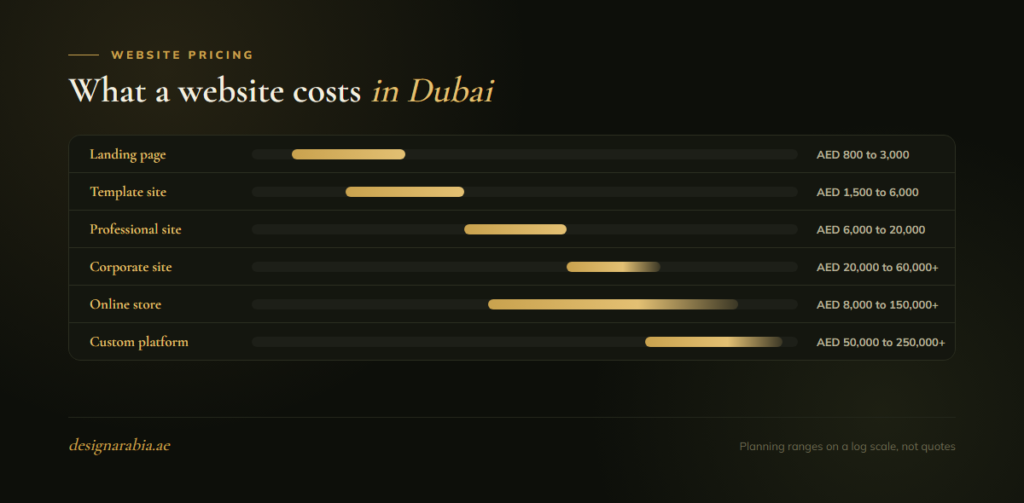
If you are asking how much a website costs in Dubai, the honest answer is that it depends on what you are actually building: a simple online presence, a conversion-focused business website, an e-commerce store, or a custom platform. For most Dubai businesses, a realistic planning range runs from AED 1,500 for a basic template site to AED 60,000 or more for a corporate website, while online stores, portals and custom systems can go well beyond that.
The bigger question is what you are buying. Design quality, content, functionality, mobile experience, SEO readiness, security, speed, integrations and support all sit behind that price. This guide breaks down the typical cost ranges, what drives pricing in the UAE, what to budget for after launch, and how to avoid paying too much for the wrong kind of website.
Website Cost in Dubai at a Glance
These are planning ranges, not quotes. A five-page website can cost AED 2,500 when it is built from a ready-made template with supplied content. The same five pages can cost AED 25,000 once you add custom UX, copywriting, Arabic and English content, lead tracking and conversion testing.
| Website type | Typical range (AED) | What it usually means |
|---|---|---|
| Landing page | 800 to 3,000 | One page for a campaign, event or single offer |
| Template-based business site | 1,500 to 6,000 | Existing theme, supplied content, a handful of pages |
| Professional business website | 6,000 to 20,000 | Custom layouts, CMS, basic SEO, launch support |
| Corporate or content-heavy site | 20,000 to 60,000+ | Many pages, bilingual content, approvals, integrations |
| Small to mid-size online store | 8,000 to 35,000 | Shopify or WooCommerce with standard checkout |
| Advanced e-commerce | 35,000 to 150,000+ | Large catalogues, ERP sync, filtering, loyalty, multi-vendor |
| Custom web app or portal | 50,000 to 250,000+ | User roles, dashboards, payments, automation |
DIY website builders sit below all of this at roughly AED 300 to AED 3,000 a year, though that excludes your time, premium apps, photography and any real customisation.
Why Website Prices Vary So Much
Dubai has a very broad supplier market: solo freelancers, low-cost overseas teams, boutique studios, specialist e-commerce agencies and full software houses. Each has a different cost base and service model. Beyond who builds it, seven factors move the price most.
1. The type of website
A brochure site costs less than an online store, and a store costs less than a marketplace. The more your website behaves like software, the more it costs.
2. Custom design or template
Templates are faster and cheaper because the layout already exists and the provider swaps in your colours, fonts, images and content. Custom design is built around your brand and sales journey, with wireframes, mobile-first layouts and revision rounds. Neither is automatically better. A good template suits a startup that needs to launch quickly, while a premium brand, clinic, real estate firm or B2B company often benefits from custom work where trust and differentiation matter.
3. Number of pages
A 5-page site and a 50-page site are different projects. More pages mean more layout work, copywriting, image selection, on-page SEO, internal linking and testing.
4. Content quality
Many low-cost packages assume you will supply all text, images and policies. If you need the provider to write service pages, edit product descriptions or plan SEO content, the cost rises. Good content is not filler. For many Dubai businesses the website fails not because the design is poor, but because the message is vague.
5. Functionality and integrations
Booking, payment gateways, product filters, customer accounts, CRM routing, ERP sync, live chat and WhatsApp tracking each add planning, testing and admin controls behind the scenes. A feature that looks simple on screen is often not simple underneath.
6. Arabic and bilingual requirements
English and Arabic versions are common in Dubai, and Arabic is not just a translation task. It can require right-to-left layout support, different line lengths, font testing and menu adjustments across devices. If you serve Emirati customers, GCC buyers, investors or tourists, plan for it from the start rather than bolting it on later.
7. Strategy and support
A basic provider builds what you ask for. A more strategic one challenges your assumptions, refines the site map, sharpens the calls to action and plans for SEO. That costs more upfront but can prevent a weak launch or a rebuild six months later.
Cost by Website Type
Landing page
A single page for one offer, campaign or audience. A simple version with supplied content runs AED 800 to AED 3,000. A strategic version with copywriting, custom design, tracking and ad alignment runs AED 3,000 to AED 10,000+. Watch for pages that look good but lack conversion basics: clear benefits, trust signals, mobile speed, form tracking and thank-you page analytics. See our landing page design service for what a conversion-focused build includes.
Small business brochure website
Typically five to eight pages: home, about, services, contact and a basic FAQ or blog. Template-based sites run AED 1,500 to AED 6,000, and a polished custom version AED 6,000 to AED 20,000. This is often the right starting point for consultants, clinics, salons, local service providers, small agencies and restaurants who mainly need credibility and enquiries.
Corporate website
More stakeholders, more pages, stronger brand requirements and longer approvals. Expect AED 20,000 to AED 60,000+, rising further with custom photography, video, accessibility reviews or internal system integrations. The main cost driver is usually coordination, content planning and approvals rather than design alone.
E-commerce website
A small online store on Shopify or WooCommerce typically runs AED 8,000 to AED 35,000. Advanced builds with large catalogues, inventory rules, custom checkout or marketplace features run AED 35,000 to AED 150,000+. Remember that the build is only part of the budget: product photography, payment gateway fees, delivery integrations, returns, email automation and marketing all follow. Our e-commerce website development page covers what a UAE store needs.
Booking and real estate websites
A simple booking site using an existing tool runs AED 5,000 to AED 15,000, while a custom platform with multiple calendars, packages and payment logic can reach AED 20,000 to AED 80,000+. A simple real estate website runs AED 8,000 to AED 25,000, and a full property portal with listing feeds, map search and CRM integration AED 30,000 to AED 120,000+. The key cost question is whether listings are added manually, imported from a CRM, synced by API or managed in a custom dashboard.
Web applications and portals
A web app lets users log in, manage data and complete workflows. Custom apps and portals run AED 50,000 to AED 250,000+, and many are built in phases, starting with a focused first version and expanding over time.
Dubai-Specific Costs and Ongoing Expenses
VAT
The UAE standard VAT rate is 5% for most goods and services, so confirm whether a quote is inclusive or exclusive of VAT. A quote that looks cheaper may simply leave out VAT or recurring third-party fees. Ask whether you will receive a tax invoice and whether renewals are billed with VAT.
E-commerce licensing
If you sell products or services online in the UAE, check your licensing before launch. Mainland businesses generally need a trade licence that covers e-commerce activity from the relevant emirate’s economic department, such as Dubai’s Department of Economy and Tourism, and free zone companies follow their own authority’s rules. This is separate from the build cost, and licensing advice should come from the authority or a qualified business setup adviser, not your web developer.
Accessibility and local trust signals
WCAG 2.1 AA is a widely used accessibility benchmark worth building toward: strong colour contrast, keyboard-friendly navigation, descriptive alt text and clear form labels. Dubai customers also look for credibility before submitting a form, so plan for a UAE phone number, WhatsApp option, office location, trade licence details where appropriate, testimonials, case studies and clear refund or delivery policies.
Costs after launch
The build is not the only cost. Budget for:
- Domain and hosting: annual domain renewal, plus hosting that matches your traffic. Register the domain under your company account, not a freelancer’s personal one.
- Maintenance: CMS, plugin and theme updates, backups, uptime and security monitoring, and small fixes. Modest for a brochure site, essential for e-commerce.
- Software subscriptions: form plugins, booking systems, page builders, email tools, CRM and translation plugins.
- SEO and content: a new website does not automatically bring traffic. Competitive Dubai sectors such as real estate, clinics, legal, hospitality and business setup usually need ongoing SEO and content work.
- Security: SSL, two-factor authentication, a firewall, spam protection and regular malware scanning, even for small sites.
Freelancer, Agency or Platform: Choosing Who and What
Freelancer vs agency vs in-house
A freelancer can be a cost-effective choice for simple sites and landing pages, with direct communication and lower cost, but with limited capacity and a single point of failure. An agency usually costs more because it brings a project manager, designer, developer, copywriter, SEO specialist and tester, which suits established businesses, e-commerce and corporate sites where mistakes are expensive. An in-house team gives control but is rarely the cheapest route unless digital product development is central to your business. For most small and mid-size companies, an external provider plus an internal owner works best.
WordPress, Shopify, Webflow or custom
- WordPress suits service businesses, SEO content and flexible page editing, with WooCommerce for small to medium stores. It needs ongoing updates and good plugin choices. Our WordPress development page explains how we approach it.
- Shopify suits product businesses that want a fast launch with standard checkout and built-in order management. Watch monthly fees and app costs.
- Webflow suits design-led marketing sites and landing pages, though advanced functionality may need integrations.
- Wix and Squarespace suit very small sites and portfolios, but can be limiting later.
- Custom development suits SaaS, marketplaces, portals and complex workflows, with higher upfront cost and ongoing technical support.
What a Good Quote Includes and the Red Flags
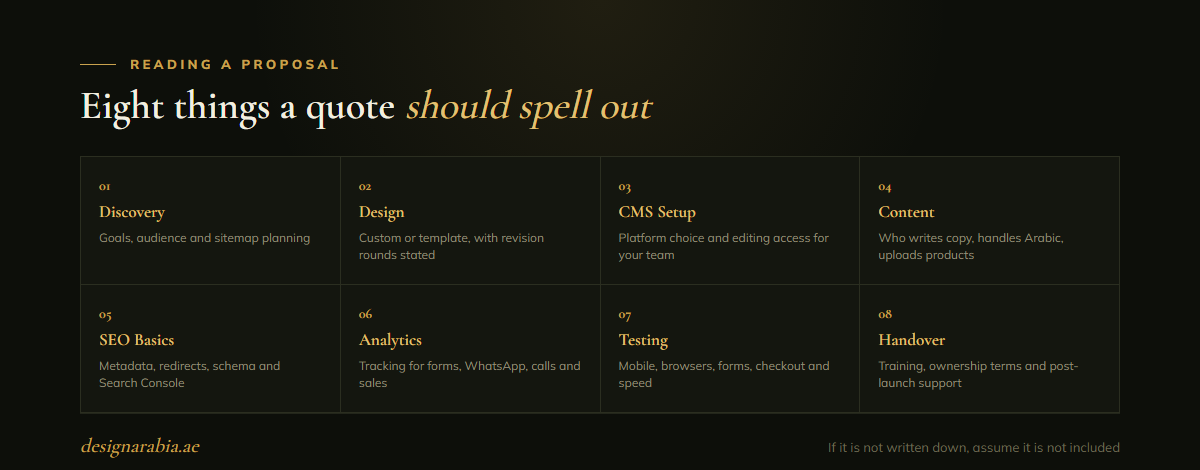
A good proposal explains exactly what you are paying for. If something is not written down, assume it is not included.
Hidden costs to ask about
Before signing, ask whether the quote covers domain and hosting setup, SSL, premium theme or plugin licences, stock images, copywriting, Arabic translation, product uploads, redirects from your old site, payment gateway setup, training, a bug-fix period after launch, backups, additional revision rounds and VAT.
Red flags in low-cost quotes
A low price is not automatically bad, but be careful with:
- “Unlimited pages” with no clear scope. Limits are usually hidden elsewhere: repeated templates, minimal content help or poor testing.
- No mention of mobile responsiveness. Most visitors will see your site on a phone.
- No CMS access. If you cannot edit your own content, you pay for every small change.
- No ownership clarity. You should know who owns the domain, hosting account, design files, code and licences.
- No SEO basics or analytics. Without them, you cannot measure leads or sales.
- Very fast delivery for a complex site. A serious store or portal needs planning, testing and approvals.
- No post-launch support. Forms, tracking and integrations often need adjustment after launch.
Questions to ask a web design company in Dubai
- How many pages, design concepts and revision rounds are included?
- Is the design custom or template-based, and is copywriting or Arabic included?
- Will we have CMS access, and can another developer maintain the site later?
- Which paid plugins or apps are required, and who owns the licences?
- Is VAT included, what is the payment schedule, and what happens if the scope changes?
- What support is included after launch, and what are the renewal costs?
How to Budget and Get Better Value
A simple budgeting process
- Define one primary goal: credibility, leads, sales, bookings or a business process. A site with one clear goal is easier to scope and price.
- List the must-have pages for launch only. You can add more later.
- Separate must-have from nice-to-have features. A contact form, WhatsApp button, CMS editing, mobile design, basic SEO and analytics are must-haves. Advanced animation, calculators and complex integrations can wait.
- Choose the quality level: quick and basic, professional and reliable, premium and conversion-focused, or custom and scalable.
- Add a post-launch budget for hosting, maintenance, SEO, content and improvements.
Example budgets
- Startup service business: AED 2,500 to AED 8,000 for a simple five-page site with a clear offer, WhatsApp and contact form, and basic SEO.
- Growing SME: AED 8,000 to AED 25,000 for custom or semi-custom design, dedicated service pages, conversion-focused copy, case studies, local SEO structure and lead tracking.
- Premium or corporate brand: AED 25,000 to AED 75,000+ for custom UI, bilingual content, accessibility, security and a professional handover.
- Small e-commerce brand: AED 8,000 to AED 35,000 for the build, excluding inventory, photography, licensing, fulfilment and marketing.
- Custom platform or marketplace: AED 50,000 to AED 250,000+ for a focused first version, with phased development after.
How long it takes
Typical planning ranges are 1 to 2 weeks for a landing page, 2 to 5 weeks for a small brochure site, 4 to 8 weeks for a professional business site, 8 to 16 weeks for a corporate site, 4 to 10 weeks for a small online store, and 10 to 20+ weeks for advanced e-commerce. Delays usually come from unclear scope, slow content delivery and late feedback, not from development itself.
When a cheap website is enough, and when to spend more
A low-cost website is fine if you are testing an idea, need basic credibility, do not depend on search traffic, can supply all the content and are happy with a template. Spend more when the website is a main source of leads or sales, when you compete in a premium market, run paid ads, sell online, need Arabic and English, or need integrations and strong security. If you are spending heavily on ads or sales staff, sending traffic to a weak website costs more than building a better one.
The real cost of a bad website is lost enquiries, poor mobile experience, slow pages, low trust, weak search visibility and an expensive rebuild later. The question is not “what is the cheapest website I can get?” but “what website will support my goals without creating problems?”
Frequently Asked Questions
How much does a basic website cost in Dubai?
Around AED 1,500 to AED 6,000 for a template-based site with a small number of pages. A more custom, professional small business website typically costs AED 6,000 to AED 20,000.
How much does an e-commerce website cost in Dubai?
A small store starts around AED 8,000 to AED 35,000. Advanced builds with integrations, large catalogues or marketplace features can cost AED 35,000 to AED 150,000+.
Why do some Dubai agencies charge much more than others?
Higher prices can reflect deeper strategy, custom design, stronger copywriting, senior developers, project management, SEO and post-launch support. Sometimes they simply reflect overhead, so always compare scope rather than the total.
Is WordPress cheaper than Shopify?
It depends. WordPress often has lower platform costs but needs hosting, maintenance and security management. Shopify has subscription and app costs but includes many store features out of the box.
Do I need Arabic on my Dubai website?
Not always, but it is valuable if you serve Emirati customers, Arabic-speaking residents, GCC buyers or government-related audiences. Budget for proper translation, right-to-left layout and testing.
Are SEO services included in website development?
Basic SEO setup often is, but ongoing SEO usually costs extra. Check whether the quote covers keyword research, metadata, redirects, schema and Search Console setup.
What should I prepare before requesting a quote?
Your goals, preferred launch date, page list, examples of sites you like, required features, brand assets, content status, language needs and integrations. The clearer your brief, the more accurate the quote.
Final Thoughts
Start by defining the outcome you need. A credibility website can be affordable, a lead-generation website needs stronger messaging and SEO structure, an online store needs operational planning, and a custom platform needs product strategy and long-term support. Use the ranges above as a starting point, then ask providers for itemised proposals. The best website for your business is not the most expensive one. It is the one with the right scope, platform, content and plan for growth. If you want an itemised estimate for your project, you can request a free quote.