
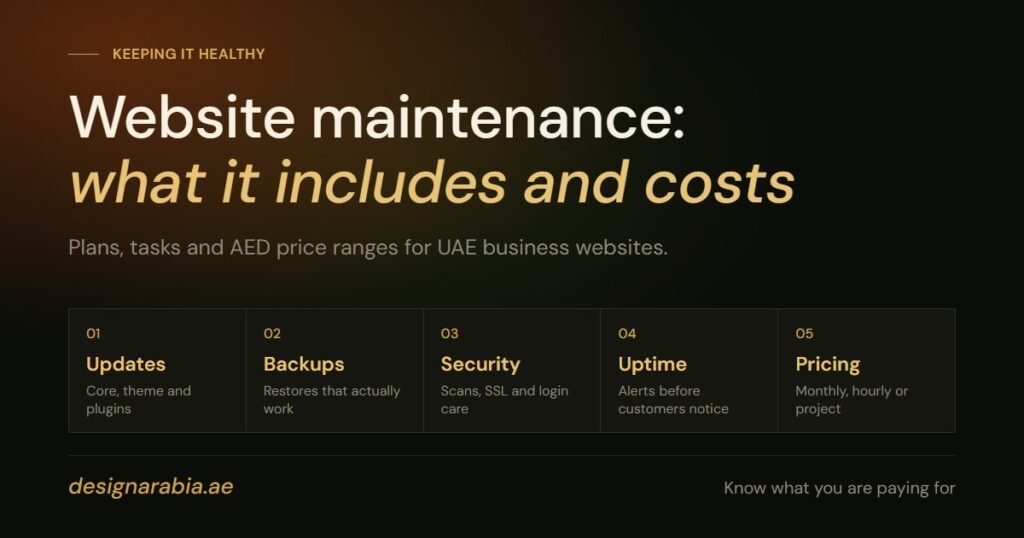
Website maintenance is the ongoing work that keeps your site secure, updated, fast, backed up, and ready for customers. For UAE businesses, it is especially important because many websites act as lead engines, booking tools, ecommerce stores, or WhatsApp enquiry channels, not just online brochures. This guide explains what website maintenance services usually include, how website maintenance costs are commonly structured in AED, and how to choose a provider that fits your site, risk level, and growth plans.
What does website maintenance include?
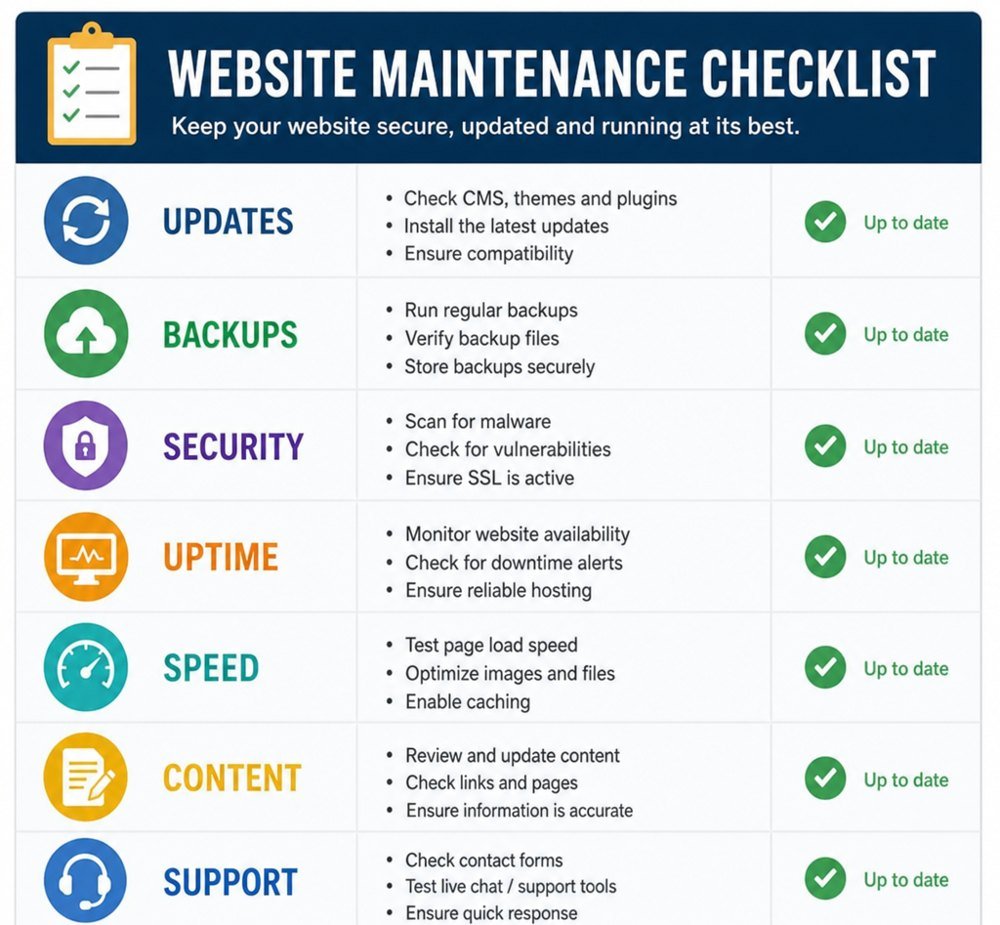
Website maintenance includes the technical, security, content, and support tasks needed to keep a website working properly after launch. At a practical level, this means someone is checking the site, applying updates, protecting it from threats, backing it up, improving speed, monitoring uptime, handling content changes, and providing support when something breaks or needs attention.
A good maintenance plan should be clear about what is included, how often work is done, and what happens when an issue is urgent. In the UAE, where customers often browse on mobile, compare suppliers quickly, and expect fast contact options, even small website problems can affect enquiries and sales.
Core maintenance tasks to expect
- Updates: CMS, theme, plugin, module, and framework updates help reduce compatibility issues and security risks. This is especially important for WordPress sites, where outdated plugins are a common source of problems.
- Backups: Regular backups protect your website files and database so the site can be restored if an update fails, content is deleted, or the site is compromised.
- Security: Maintenance may include malware scans, firewall configuration, SSL checks, spam protection, login hardening, and suspicious activity monitoring.
- Uptime monitoring: Uptime checks alert your provider if the site goes offline, so downtime can be investigated quickly instead of being discovered by customers.
- Speed optimisation: Speed work may include caching, image compression, database cleanup, code review, and hosting checks. Faster pages help user experience, especially on mobile connections.
- Content changes: Many plans include minor edits such as changing banners, updating service pages, adding team profiles, replacing images, or posting announcements.
- Support: Support gives you a defined way to request help, report bugs, ask technical questions, or get advice before making changes.
For ecommerce sites, maintenance usually goes further. Checkout flows, payment gateways, stock display, shipping settings, discount codes, product pages, and transactional emails may all need routine checks because small errors can directly affect revenue.
How much should a UAE business budget for website maintenance?
As a rough estimate, many UAE businesses can expect website maintenance costs to start from a few hundred AED per month for a small brochure site and rise into the thousands of AED per month for complex ecommerce or custom platforms. Typical UAE market ranges place standard WordPress maintenance around an estimated AED 350 to AED 800 per month, while ecommerce maintenance can be roughly AED 1,500 to AED 4,500 or more per month depending on scope, monitoring, and backup frequency.
These figures should be treated as approximate ranges, not fixed or guaranteed prices. A five-page company website with low traffic and occasional edits is very different from a multilingual ecommerce site with hundreds of products, payment gateway integrations, CRM forms, and campaign landing pages.
Rough UAE maintenance cost ranges
| Website type | Rough monthly estimate in AED | Typical maintenance needs |
|---|---|---|
| Small brochure website | AED 250 to AED 800 | Updates, backups, security checks, uptime monitoring, minor edits |
| WordPress business website | AED 350 to AED 1,500 | Plugin updates, theme checks, backups, speed fixes, form testing, content support |
| Content-heavy or multilingual site | AED 800 to AED 2,500 | More edits, language updates, SEO checks, performance monitoring, stronger support |
| Ecommerce site | AED 1,500 to AED 5,000+ | Checkout monitoring, product updates, payment checks, daily backups, priority support |
| Custom web application | AED 2,500+ | Developer support, server monitoring, bug fixes, integration testing, code releases |
Some providers in Dubai offer care plans starting around AED 350 to AED 500 per month, while others charge more for priority support, included hosting, ecommerce monitoring, or more development hours. Hosting may also be billed separately, sometimes as an annual line item, so always check whether hosting, domain renewal, SSL, and email support are included or separate.
Common pricing models for website maintenance services
Website maintenance services are usually priced in one of three ways: monthly plans, hourly rates, or per project pricing. The right model depends on how often you need help, how business-critical the site is, and whether your work is predictable or occasional.
Monthly plans
A monthly plan, sometimes called a maintenance retainer or website AMC in the UAE, gives you ongoing support for a recurring fee. It often includes a set list of tasks such as updates, backups, uptime monitoring, security checks, and a limited number of content change requests.
This model works well for businesses that rely on their website every week, such as clinics, real estate firms, restaurants, training companies, consultants, and ecommerce brands. The main benefit is continuity: your provider understands your site and checks it regularly instead of only responding after something breaks.
Hourly rates
Hourly pricing is used when work is irregular or outside the scope of a monthly plan. For example, you might pay by the hour for troubleshooting a broken form, fixing a plugin conflict, improving page speed, adjusting a landing page, or investigating a server issue.
Hourly work can be useful for smaller businesses that only need occasional help. However, it can become expensive or unpredictable if your site needs frequent fixes. It also depends heavily on response time, because urgent work may be charged differently from scheduled tasks.
Per project pricing
Per project pricing is used for defined jobs with a clear outcome. Examples include migrating a website to a new host, cleaning a hacked site, adding Arabic language pages, setting up ecommerce tracking, rebuilding a checkout flow, or optimising a group of high-value pages.
This model is best when the task has a beginning and an end. It is less suitable for ongoing protection, because once the project is complete, your site still needs updates, backups, security monitoring, and support.
Quick comparison
- Choose a monthly plan if your website is important to daily leads, bookings, sales, or brand trust.
- Choose hourly support if your site is simple and you only need help from time to time.
- Choose per project pricing if you need a specific upgrade, repair, migration, or one-off improvement.
Factors that affect website maintenance costs
Website maintenance costs vary because websites vary. Two companies may both ask for “maintenance,” but one may need a monthly plugin update and the other may need a technical team watching ecommerce payments, server performance, and conversion tracking.
Key cost factors include:
- Website platform: WordPress sites often have predictable maintenance needs around plugins, themes, and core updates. Custom platforms may need developer-level support, which usually increases the rough cost.
- Site size: More pages, forms, media files, languages, and templates mean more items to test after updates.
- Ecommerce functionality: Ecommerce sites typically cost more to maintain because payment gateways, carts, coupons, inventory, shipping, and order emails must work correctly.
- Traffic and business impact: A high-traffic site or lead generation site may need faster response times, stronger hosting, and more monitoring.
- Backup frequency: Weekly backups may be enough for a static business website, while active ecommerce sites may need daily or more frequent backups.
- Security risk: Sites collecting customer data, taking payments, or using many plugins may need stronger security checks.
- Content update volume: A company that changes offers, events, vacancies, property listings, or product details every week will need more support time.
- Integrations: CRM, ERP, WhatsApp, booking systems, analytics, payment gateways, and email marketing tools add testing and troubleshooting work.
- Service level: Faster turnaround, weekend support, emergency support, and dedicated account management usually increase the monthly estimate.
- Hosting quality: Poor hosting can create speed, uptime, and security problems, which increases maintenance effort.
This is why the cheapest plan is not always the most cost-effective. If a low-cost plan does not include backups, security, uptime monitoring, or support response times, the business may still be exposed when something goes wrong.
WordPress and ecommerce maintenance need different levels of care
WordPress is popular because it is flexible, scalable, and easy for teams to update. That flexibility also means the site needs routine care. WordPress website maintenance (part of our WordPress development work) should include core updates, plugin updates, theme checks, backup verification, security scans, form testing, and performance reviews.
Ecommerce sites need a more careful process because every technical issue can affect orders. A WooCommerce, Shopify, Magento, or custom ecommerce site may need checkout testing, payment gateway checks, product feed review, abandoned cart email checks, coupon testing, and mobile usability checks. In the UAE, this can also include checking local payment options, delivery rules, VAT display, Arabic and English content, and WhatsApp enquiry paths where relevant.
If your ecommerce store runs paid ads, maintenance becomes even more important. A slow product page, broken checkout, or failed tracking script can waste advertising spend before anyone notices.
Choosing a website maintenance provider in the UAE
The best provider is not simply the cheapest one. For UAE businesses, the right website maintenance partner should understand local customer behaviour, mobile-first browsing, bilingual content needs, lead generation habits, and the importance of fast support during business hours.
Use this checklist before choosing a provider:
- Ask for a clear scope: Confirm exactly what is included, such as updates, backups, security, uptime, speed checks, content changes, and support.
- Check response times: Ask how urgent issues are handled and whether there are different response levels.
- Confirm platform experience: Make sure they understand your platform, whether it is WordPress, Shopify, WooCommerce, Magento, or custom-built.
- Review backup and restore process: Backups are only useful if they can be restored quickly and correctly.
- Ask about UAE hosting needs: A provider should understand performance, reliability, and regional audience expectations.
- Clarify content limits: If you need frequent Arabic and English updates, campaign pages, or product uploads, confirm how many changes are included.
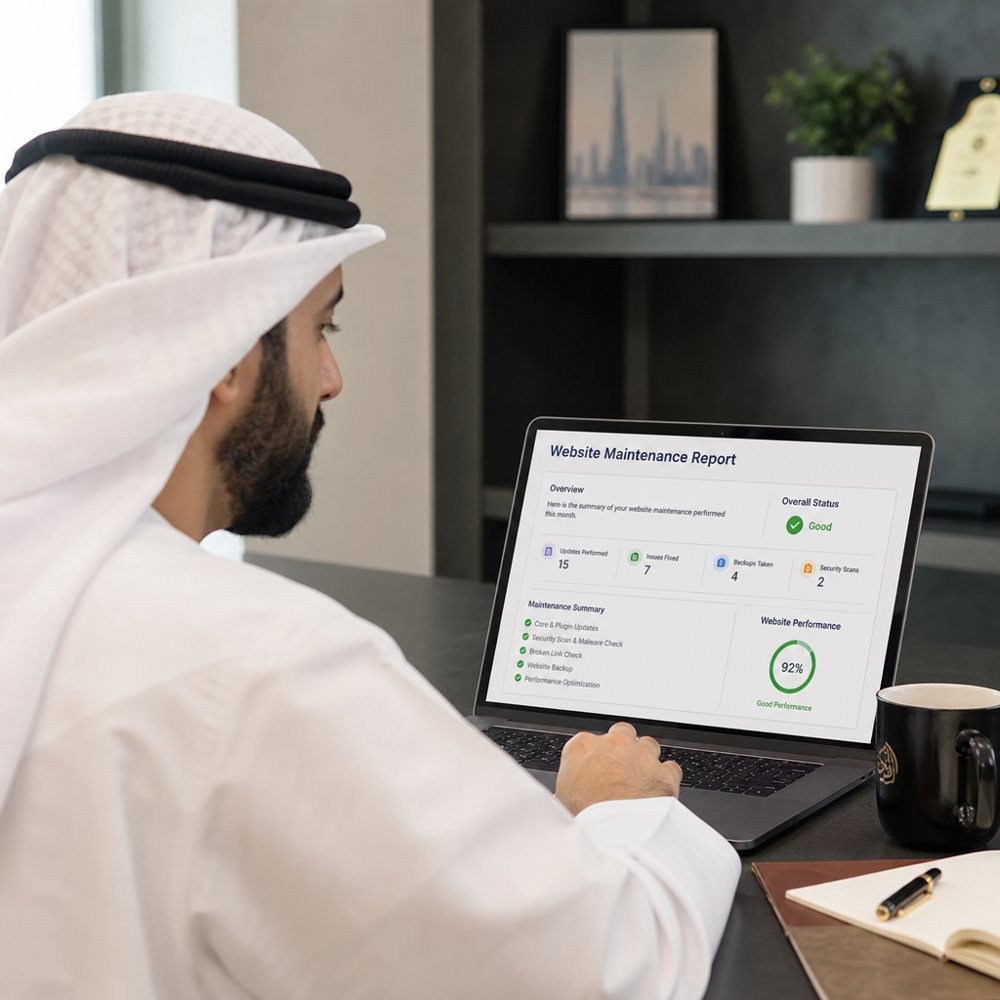
- Look for reporting: A monthly report showing updates, backups, uptime, security checks, and completed requests helps you see what you are paying for.
- Avoid vague promises: “Unlimited support” or very low pricing may hide limits, slow response, or exclusions.
Before signing, ask the provider to audit your current website. A quick technical review can reveal outdated plugins, slow hosting, missing backups, broken forms, or security gaps that affect the maintenance estimate.
A practical way to plan your maintenance budget
Start by ranking your website by importance. If it is mainly a digital brochure, a basic monthly plan may be enough. If it generates enquiries, bookings, or ecommerce revenue, you should budget for stronger monitoring, faster support, and more frequent backups.
A simple planning approach is:
- List what your website must do every day, such as forms, calls, WhatsApp clicks, bookings, payments, or product searches.
- Identify what would cost you money if it stopped working.
- Decide how quickly you need problems fixed.
- Choose the pricing model that matches your risk level.
- Review the plan every few months as traffic, content, and features grow.
Website maintenance is not just a technical expense. It protects your customer experience, your marketing spend, and the trust people place in your business when they find you online.
Keep your website reliable, secure, and ready for growth
If your site needs stronger hosting, better uptime, or a maintenance setup that supports UAE business needs, start by reviewing your hosting foundation on our web hosting page. For a tailored estimate based on your platform, website size, update needs, and support expectations, request a customised AED quote.
A well-maintained website is easier to trust, easier to improve, and easier to scale. If you are still planning the build, read our website cost guide for Dubai and our website launch checklist. Whether you run a WordPress company site, a multilingual corporate website, or an ecommerce store, the right maintenance plan helps you avoid avoidable problems and keep your online presence working for your business.