
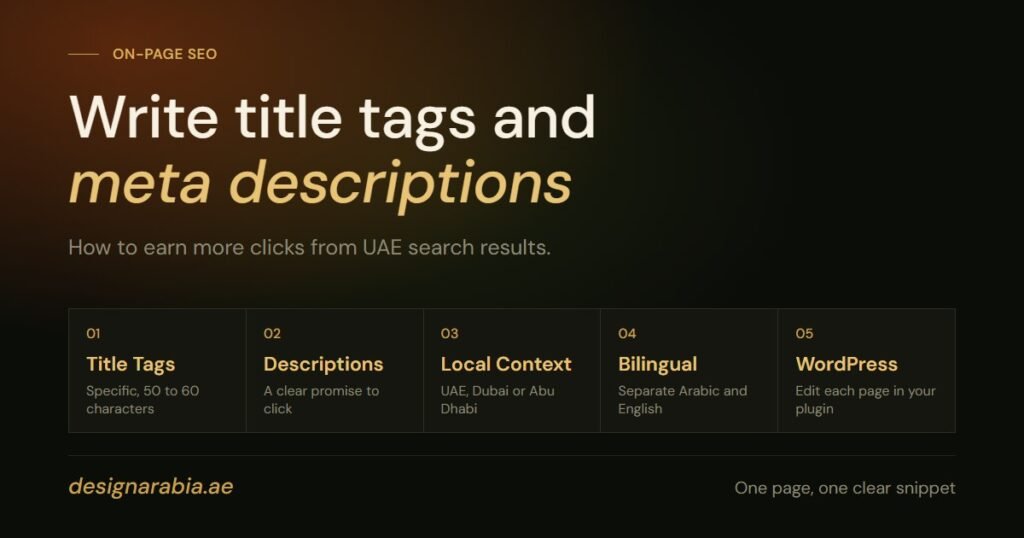
Title tags and meta descriptions are two of the most visible SEO elements on a search results page. For UAE business owners and marketers, they help explain what a page is about, attract the right clicks from people searching in English or Arabic, and support clearer search engine understanding. Well-written tags will not fix weak content on their own, but they can improve how your pages appear and how confidently users choose your result.
What are title tags and meta descriptions?
A title tag is the HTML page title that search engines often show as the blue clickable headline in search results. A meta description is the short summary that may appear below that headline. Together, they act like your organic search advert: the title tells users what the page offers, and the description gives them a reason to click.
Although people often group them under seo meta tags, the title tag is technically not a meta tag. In practical SEO work, however, title tags, meta tags, and descriptions are usually managed together because they shape how your page is presented in Google and other search engines.
For UAE businesses, this matters because search intent can be local, bilingual, and highly competitive. A customer in Dubai searching for “AC repair near me,” a company in Abu Dhabi comparing B2B suppliers, or a shopper looking for “same day delivery UAE” all make quick decisions from search results. Your title tag and meta description must show relevance, location, trust, and value quickly.
Why do they matter for clicks and rankings?
Title tags matter for rankings because search engines use them as one signal to understand the topic and relevance of a page. Meta descriptions are generally not treated as a direct ranking factor, but they can influence clicks by helping users decide whether your page matches their need. When more qualified users choose your result, your organic traffic can improve even if your ranking position stays the same.
Think of the title tag as the label on a shopfront in Dubai Mall or a business sign on Sheikh Zayed Road. If it is vague, people pass by. If it clearly says what you offer, where you operate, and why it is relevant, it earns attention.
Strong title tag optimization supports SEO by:
- Matching the main keyword and page topic clearly.
- Helping search engines distinguish one page from another.
- Making the result more relevant to local UAE searches.
- Encouraging clicks from users who are ready to compare, enquire, book, or buy.
A strong meta description supports performance by:
- Summarising the page in plain language.
- Highlighting the benefit or next step.
- Including local context such as UAE, Dubai, Abu Dhabi, Sharjah, or GCC where relevant.
- Setting accurate expectations so users do not bounce because the page feels unrelated.
Search engines may rewrite titles or descriptions when they believe another snippet better matches the query. That is normal. Your job is to provide a clear, useful version that gives search engines and users a strong starting point.
The core rules for effective title tags
A title tag should be specific, readable, and unique to the page. For most pages, aim for around 50 to 60 characters. This is not a fixed rule because display length depends on pixel width, but it is a practical range that reduces the chance of important words being cut off.
Place the primary keyword near the beginning when it reads naturally. For example, “Corporate Tax Consultants in Dubai” is clearer than “Trusted Local Experts for Companies Looking for Help With Corporate Tax.” If the page targets a UAE city or national audience, include that location when it is meaningful.
Branding also matters. For homepages, category pages, and important service pages, adding your brand name can build recognition. A common format is:
- Primary Keyword in Location | Brand Name
- Service or Product Benefit in UAE | Brand Name
- Page Topic for Audience | Brand Name
Avoid using the same title tag across multiple pages. Duplicate titles make it harder for search engines and users to understand which page is the best match. A Dubai SEO services page, an Abu Dhabi SEO services page, and an ecommerce SEO page should each have a distinct title that reflects the page content.
How do you write a meta description that earns clicks?
A good meta description answers the user’s silent question: “Is this page worth opening?” Aim for around 140 to 160 characters as a practical guideline. It should include the main keyword or a close variation, describe the page accurately, and end with a useful reason to act.
The description should not be a list of keywords. It should read like a short promise that the page can keep. For example, a page about villa landscaping in Dubai might mention design, maintenance, and UAE climate suitability if those topics are actually covered on the page.
Use this simple structure:
- State the offer or topic: Tell the user what the page covers.
- Add a benefit or qualifier: Mention speed, expertise, location, range, support, or suitability if true.
- Invite action: Use a soft call to action such as “Request a quote,” “Explore services,” or “Shop online.”
For UAE audiences, local clarity improves usefulness. If the page serves all Emirates, say UAE. If it serves one city, say Dubai, Abu Dhabi, Sharjah, Ajman, or the relevant area. If the page is bilingual, make sure the description matches the page language and search intent.
Writing for English and Arabic search in the UAE
Many UAE websites need to serve both English and Arabic users. Do not simply translate title tags and meta descriptions word for word. Search behaviour, phrasing, and reading direction can differ, so each language version should be written for real users in that language.
For English pages, use the terms your target audience actually searches for, such as “business setup in Dubai,” “SEO agency UAE,” or “online flower delivery Dubai.” For Arabic pages, use natural Arabic phrasing rather than awkward keyword insertion. If your Arabic users search with mixed English terms, such as brand names, product types, or locations, include them only where they feel natural.
Best practices for bilingual content include:
- Create separate title tags and descriptions for English and Arabic URLs.
- Keep each version aligned with the page content in that language.
- Avoid mixing English and Arabic unless your audience commonly does so.
- Review Arabic length visually, not only by character count, because display space can vary.
- Make local terms clear, especially city names, delivery areas, and service coverage.
Practical examples for UAE businesses
The following meta description examples show how weak tags can become clearer, more useful, and more search focused.
UAE service business example
Assume the page is for an AC maintenance company serving Dubai homes and offices.
| Element | Before | After |
|---|---|---|
| Title tag | Home | AC Maintenance in Dubai |
| Meta description | We provide the best services. Contact us today for more information. | Book AC maintenance in Dubai for villas, apartments, and offices. Get clear service details and request a quote from CoolAir Services. |
The improved title places the service and location first, then adds the brand. The improved description explains who the service is for and gives the user a clear next step. It avoids vague claims and matches a local UAE search more closely.
UAE online store example
Assume the page is for an ecommerce category selling running shoes across the UAE.
| Element | Before | After |
|---|---|---|
| Title tag | Products | Running Shoes UAE |
| Meta description | Buy products online from our store. We have many items available. | Shop running shoes in the UAE for training, walking, and everyday wear. Browse men’s and women’s styles and order online. |
The improved title is specific to the category and market. The description gives shoppers context before they click, which is especially important for online stores with many similar product pages.
A checklist for title tag optimization and descriptions
Use this checklist before publishing or updating any important page:
- One main topic per page: The title and description should match the actual page content.
- Primary keyword included naturally: Use terms such as title tag optimization, meta description, or your service keyword only where relevant.
- Location added when useful: Include UAE, Dubai, Abu Dhabi, or another Emirate if the page targets that market.
- Brand name used thoughtfully: Add it to key commercial pages, but do not let it crowd out the main topic.
- Unique copy for every indexable page: Do not repeat the same tags across services, products, blogs, and locations.
- Clear user benefit: Explain what the visitor can do, learn, compare, book, or buy.
- No misleading promises: The search snippet should match the page users land on.
- Language matched to the page: English pages need English tags, Arabic pages need Arabic tags, and bilingual sites need separate optimisation.
Common mistakes to avoid
Many UAE business websites lose clarity because their tags are written as an afterthought. The most common issue is using generic titles such as “Home,” “Services,” or “Products.” These do not tell search engines or users enough about the page.
Another mistake is stuffing keywords into every available space. A title like “SEO Dubai, SEO UAE, SEO Company Dubai, SEO Agency UAE” looks spammy and weakens readability. Choose the strongest phrase and write for humans first.
Other mistakes include:
- Descriptions that are too vague: “We are a leading company” says little about the page.
- Descriptions that are too long: Important information may be cut off in results.
- No local relevance: A UAE service page should make service area clear where appropriate.
- Duplicate tags: Similar pages need distinct positioning.
- Missing page intent: A blog, product page, and contact page should not sound the same.
- Overpromising: Avoid claims such as guaranteed rankings unless you can support them and they are appropriate.
How to edit title tags and meta descriptions in WordPress
Most WordPress websites use an SEO plugin to manage page-level metadata. The exact interface depends on your plugin, but the process is usually simple enough for business owners and marketing teams.
Follow these steps:
- Log in to WordPress and open the page, post, product, or category you want to optimise.
- Find the SEO plugin panel below or beside the editor. Common plugins provide fields for SEO title and meta description.
- Write a unique SEO title using the main keyword, location if relevant, and brand name when useful.
- Write the meta description as a clear summary with a benefit and action.
- Check the preview to see whether the title or description may be too long.
- Update or publish the page once the tag matches the page content.
- Review important pages regularly when services, offers, locations, or product ranges change.
For UAE websites with Arabic and English pages, edit each language version separately, and read our guide to Arabic SEO for GCC businesses for the wider picture. If your site uses a translation plugin, check that each translated URL has its own title tag and meta description rather than copying the English version automatically.
Turn search snippets into better first impressions
Title tags and meta descriptions are small pieces of copy with a large role in organic search presentation. They help search engines understand your pages, help users choose the right result, and help UAE businesses communicate relevance in a crowded market.
If you manage a UAE business website, start with your highest value pages: homepage, core services, product categories, location pages, and lead generation pages. Improve one page at a time, keep every tag specific, and write for the person deciding whether to click.
Ready to improve your search visibility and on-page quality? Visit our on-page SEO services page to get support with title tags, meta descriptions, content structure, and practical optimisation for your UAE business website.