
Dubai is one of the most connected retail markets in the region, but launching an online store here takes more than uploading product photos to a basic website. You need the right licence, a platform that suits your catalogue, payment methods people actually use, reliable delivery and a plan for getting found.
This guide walks through the ecommerce solutions in Dubai that a store genuinely needs, in the order most founders run into them. Whether you are starting an online business in Dubai from scratch or moving an existing shop online, and are comparing the ecommerce solutions Dubai agencies and platforms offer, use it as a checklist for the decisions ahead.
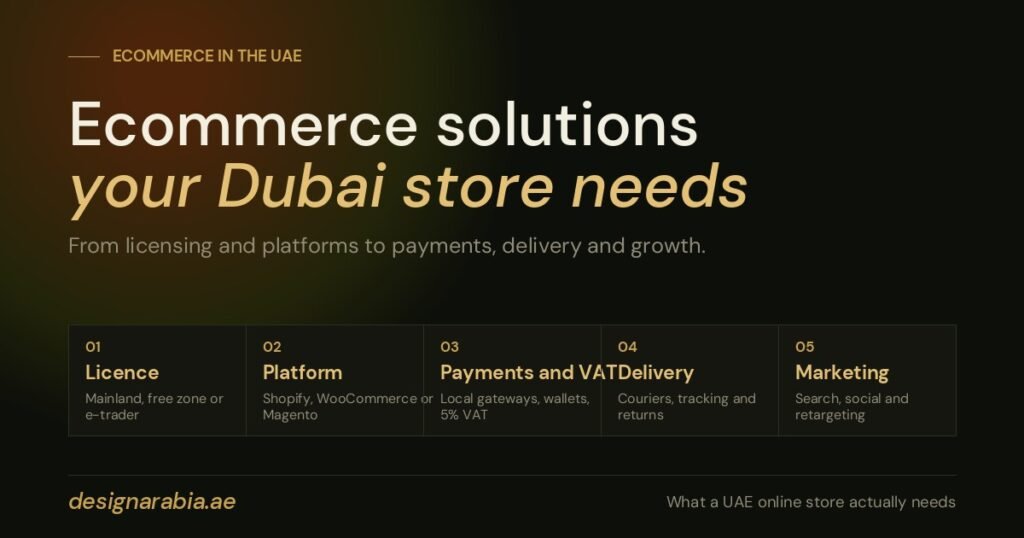
The five things a Dubai online store needs
- Licence: mainland, free zone or e-trader, matched to how and where you sell
- Platform: Shopify, WooCommerce, Magento or custom, chosen for your catalogue and growth plans
- Payments and VAT: local gateways, wallets, buy now pay later and correct 5% VAT invoicing
- Delivery: couriers, tracking, returns and inventory that keeps up with orders
- Marketing: search, social and retargeting that bring in the right shoppers
1. Legal and licensing: the first step
Before you build anything or source stock, make sure your business is allowed to trade online. Rules and fees change, so confirm current details with the licensing authority or a business setup adviser before you commit.
Mainland, free zone or e-trader
- Mainland: suits businesses that want to sell directly to the UAE market without a local distributor, or that plan a physical shop alongside the online store.
- Free zone: usually offers full foreign ownership and tax advantages, but selling physical goods into the mainland generally means working through a licensed local distributor or an additional arrangement.
- E-trader licence: aimed at individuals and small sellers who trade through social media or a personal website without a physical office. Eligibility and fees are set by the authority, so check the official Dubai Economy portal for the current terms.
If you are weighing a dedicated ecommerce free zone such as Dubai CommerCity, ask what is bundled in, for example warehousing, payment partners and last-mile delivery, and compare that against a mainland setup for your product type.
2. Budgeting: what an online store really costs
“How much does it cost to start an online store in Dubai?” has no single answer, because it depends on scale, platform and legal setup. These are rough planning ranges to help you frame the conversation, not quotes:
- Licensing and registration: from a few thousand dirhams for a small e-trader setup to AED 25,000 or more for a mainland or free zone company.
- Platform and hosting: from around AED 1,000 to AED 10,000 or more per year, before design and development.
- Payment gateway fees: setup is often free, but expect per-transaction fees, commonly in the region of 2.5% to 2.9% plus a small fixed amount. Confirm the exact rate with the provider.
- Marketing: plan a monthly budget for the first few months to build traction. For many stores that starts in the thousands of dirhams per month.
- Inventory and warehousing: highly variable, depending on your product.
A common mistake is spending the whole budget on the build. A store nobody visits earns nothing, so set aside a real share of your starting capital, many founders aim for around 40%, for marketing and customer acquisition. Our guide to website costs in Dubai breaks the build side down in more detail.
3. Choosing your store platform and hosting
The platform is the most important technical decision you will make. Match it to your catalogue and how fast you expect to grow.
- Shopify and Shopify Plus: easy to manage, hosted for you and backed by a large app store. A strong fit for startups and mid-sized brands that want to launch quickly. Watch monthly fees and app costs as you scale.
- WooCommerce: flexible and well suited to content-led brands already on WordPress. Our WordPress development team builds on it regularly.
- Magento (Adobe Commerce): built for large catalogues, deep customisation and multi-store setups, for example separate stores for the UAE, Saudi Arabia and Oman on one back end. It needs a dedicated development team and a bigger budget.
If you choose a self-hosted platform, server location matters. Hosting close to your customers, in or near the UAE, reduces latency and helps pages load faster for local shoppers. If you host abroad, put a content delivery network such as Cloudflare in front so content is cached closer to your visitors. Our web hosting page covers the options, and our guide to choosing an ecommerce development company helps you pick the team that builds it.
4. Building a localised shopping experience
The UAE is home to many nationalities, so a good store works for expats and Emiratis alike.
Arabic, properly done
English is widely spoken, but many shoppers prefer to buy in Arabic. Running your English site through machine translation is not enough. You need right-to-left layouts that flip cleanly, product descriptions written or checked by native speakers, and Arabic keywords researched on their own rather than translated from English. Our guide to Arabic SEO for GCC businesses explains the search side.
Multi-currency for the GCC
Dubai is often the launchpad for wider GCC expansion. Letting customers see prices and pay in their own currency, such as AED, SAR or OMR, removes a common reason for abandoned carts, because nobody wants to do exchange rates in their head.
Mobile first
Smartphone use in the UAE is very high, so a smooth mobile checkout, large touch-friendly buttons and links to social commerce on Instagram and TikTok are not optional. We cover the details in our post on ecommerce web design trends for UAE online stores.
5. Payments and VAT: keeping cash flow compliant
Shoppers trust a store that offers payment methods they already know. Cash on delivery was long the default in the region, but cards and wallets now carry much of the volume.
Payment options to plan for
- Card gateways: providers such as Stripe, Checkout.com, PayTabs and Telr are common choices. Ask about local support, settlement times and how refunds and failed payments are handled.
- Digital wallets: Apple Pay and Google Pay make mobile checkout a single tap.
- Buy now, pay later: instalment options such as Tabby and Tamara are now part of many shoppers’ expectations and can lift average order value.
- Cash on delivery: still used, but it needs order verification and cash reconciliation to avoid failed deliveries.
VAT for online retailers
Do not leave tax until later. The standard UAE VAT rate is 5%, and the Federal Tax Authority monitors compliance closely. As a guide, registration is mandatory once your taxable supplies and imports pass AED 375,000 over the previous 12 months or are expected to in the next 30 days, and voluntary registration is possible from AED 187,500. The UAE Government’s VAT page has the official detail. Make sure your platform calculates VAT correctly and produces compliant tax invoices, so you avoid penalties.
6. Logistics: delivering on the promise
A beautiful site and strong marketing count for little if an order arrives late or damaged. Customers rarely give a second chance.
Last-mile delivery
Addresses in the UAE have historically been less standardised than in many countries, and drivers often rely on landmarks, GPS pins and shared WhatsApp locations. Choose a courier that supports accurate location capture and integrates with your platform through an API, so tracking updates reach customers automatically. Ask any courier you shortlist about coverage across all emirates, delivery windows, cash on delivery handling and returns.
Inventory management
Spreadsheets stop working as orders grow. A warehouse or inventory system that syncs with your store in real time prevents overselling. Barcoding early speeds up picking and packing, and demand forecasting helps you prepare for peaks such as Ramadan, White Friday and the Dubai Shopping Festival, so your bestsellers do not run out when demand is highest.
7. Marketing and omnichannel growth
Once the foundations are solid, the focus turns to bringing in the right shoppers and keeping them. Generic marketing struggles in Dubai, so localise it.
- Search: make sure category and product pages target the terms UAE shoppers really use. Our ecommerce SEO service is built around this.
- Social and influencers: micro-influencers on Instagram, TikTok and Snapchat can carry real trust with local audiences.
- Google Shopping: a clean, well-optimised product feed puts your products in front of people searching for them.
- Retargeting: use the Meta Pixel and Google tags to bring back visitors who abandoned a cart, perhaps with free delivery or a time-limited offer.
You can see how these channels fit together in our approach to digital marketing for ecommerce.
Connecting online and offline
Malls are lifestyle destinations in Dubai, so the best brands blur the line between physical and digital:
- Click and collect: buy online, pick up in store or from a mall locker.
- Unified loyalty: points earned and spent the same way online and at the till.
- Endless aisle: store staff order out-of-stock items to the customer’s home from your online warehouse.
Final thoughts
Launching an online business in the UAE is a rewarding project when the groundwork is right. Start with the correct licence and a platform that suits your catalogue, then get payments, VAT and delivery working smoothly, and build a localised, bilingual experience that earns trust. Marketing and omnichannel growth sit on top of that foundation, not in place of it.
If you would like help with any part of this, from the build to the marketing, take a look at our ecommerce website development service or request a free quote and we will talk through your store.