
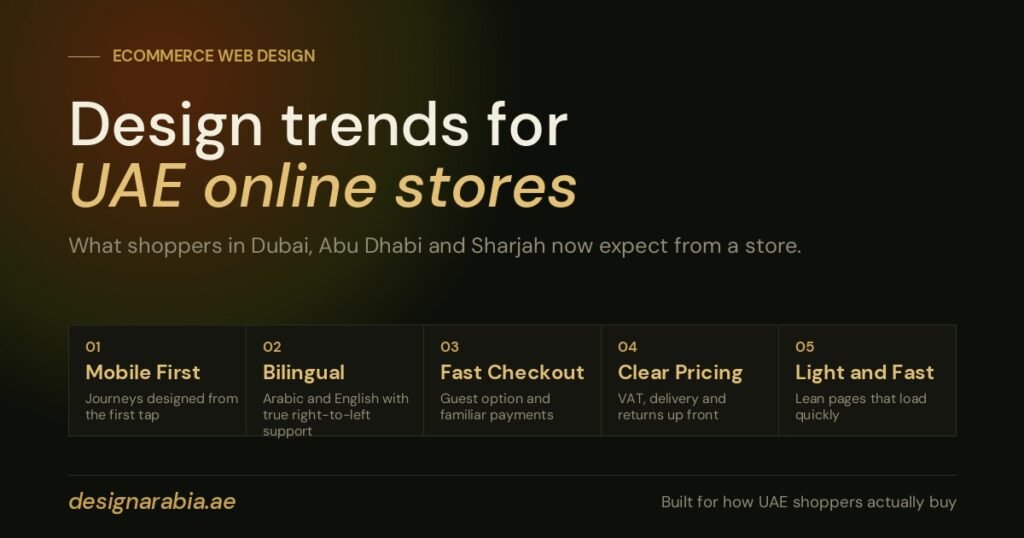
For UAE retailers, design is not just how a store looks. It decides how quickly shoppers find a product, whether they trust the shop enough to enter their card details, and whether they finish checkout on the phone already in their hand.
The numbers explain why. DataReportal’s Digital 2026 report puts internet penetration in the UAE at 99.0% at the end of 2025, and the 2025 Global Digital Shopping Index found that 67% of UAE shoppers used a phone for their most recent retail purchase. A store that only looks good on a desktop is built for a minority of its buyers.
If you are planning a new store or refreshing an existing one, these are the ecommerce web design trends worth prioritising in Dubai, Abu Dhabi, Sharjah and across the Emirates. Our ecommerce website development team sees the same patterns in almost every project we scope.
The shopper journey at a glance
- Homepage: search and clear categories
- Category page: filters, sorting and delivery badges
- Product page: VAT, delivery and returns next to the price
- Checkout: guest option, wallets and no surprises
Every stage is a place to remove friction or lose the sale, and the trends below follow that path.
1. Mobile-first layouts that feel native
Mobile-first is the baseline now. The shift is away from desktop pages that merely shrink to fit a small screen and toward journeys designed around the first tap.
A modern mobile store usually has:
- Thumb-friendly menus, filters and add-to-cart buttons
- A sticky cart or checkout action on product pages
- Product images that load fast and never block browsing
- Very few pop-ups getting in the way
- A search bar returning customers can find instantly
When you compare agencies for ecommerce web design Dubai services, ask to see the mobile product discovery, cart and checkout flow before the desktop mockups. It tells you quickly whether the team designs for the phone or just tolerates it.
2. Bilingual Arabic and English experiences
A translation plugin is no longer enough. Shoppers expect a clear language switcher, accurate product information, proper right-to-left layouts in Arabic, and the same messaging across menus, filters, checkout, emails and support pages.
This is also a trust and compliance matter. The UAE Ministry of Economy’s consumer protection guidance stresses consumers’ right to correct information, and UAE rules expect registered ecommerce providers to give sufficient Arabic information about goods, terms, payment and warranty.
Plan for Arabic from the first wireframe, not after launch. Product cards, badges, dropdowns and navigation labels change length a lot between languages, and a layout that breaks when translated breaks the experience with it. Our guide to Arabic SEO for GCC businesses covers the search side of the same problem.
3. Faster checkout with more payment confidence
Checkout is where design turns into revenue. UAE shoppers expect familiar payment methods, visible security cues, short forms and as few steps as possible. The Central Bank of the UAE oversees the country’s retail payment systems, including the card payments most stores rely on.
The trend is toward checkouts that reduce decision fatigue:
- Guest checkout offered as a visible option
- Autofill-friendly form fields
- Clear payment method icons
- Delivery costs shown before the final step
- An order summary that stays visible throughout
- Error messages that say exactly what to fix
One-click and stored-credential options matter most for returning customers. The same Global Digital Shopping Index found UAE shoppers more likely than the study average to use third-party one-click checkout for their latest online purchase.
4. Transparent pricing, VAT and delivery messaging
Hidden fees create hesitation. Make pricing, VAT, shipping, returns and delivery timing easy to understand before anyone reaches checkout. The UAE Government explains that VAT-registered businesses collect VAT on behalf of the government, and that consumers bear it through a 5% increase in the cost of taxable goods and services.
The best product pages now carry a compact block of trust and cost details:
- “VAT included” or “VAT calculated at checkout”, depending on your pricing model
- Estimated delivery by emirate or region
- A short summary of the return window
- Warranty or authenticity information
- The free delivery threshold, if there is one
Do not make people hunt for this in the footer. Put it next to the price, the add-to-cart button and the checkout summary.
5. Product pages that answer questions before they are asked
In competitive UAE categories such as fashion, beauty, electronics, furniture, food, gifting and luxury, a product page has to do more than show pictures. It has to remove doubt.
- Several high-quality images
- Clear size, colour, material or specification details
- Delivery and return notes
- Reviews or ratings where you have them
- Stock status
- Related products or bundles
- A short FAQ for complex products
If a customer has to contact support for basic information, the page is not doing its job. That matters even more for high-consideration purchases.
6. Smarter search and product discovery
Shoppers do not always know the product name. They search by occasion, style, budget, recipient or problem: “modest evening dress”, “gift for a new baby”, “office chair for a small apartment”, “same-day flowers in Dubai”.
Good discovery design supports that with predictive search, typo tolerance, synonyms and a useful no-results page that suggests categories or bestsellers instead of a dead end. AI can also help with merchandising, such as recommending complementary products or adapting suggestions to browsing behaviour. The test is whether it feels helpful rather than intrusive.
7. Speed-focused design with lighter visuals
UAE connectivity is strong, but speed still matters. Heavy sliders, uncompressed video, piles of scripts and bloated themes make even a premium brand feel frustrating.
- Optimised images in modern formats
- Short, purposeful motion instead of animation everywhere
- Fewer third-party scripts
- Lazy loading for media below the fold
- Clean product grids and simple mobile navigation
Fast does not mean plain. Luxury, minimal, bold and editorial styles all perform well when the page structure is efficient. If you suspect your current store is the problem, our website redesign service starts with exactly this kind of review.
8. Marketplace-style navigation for independent brands
Customers are used to marketplace convenience, so even a small curated store should be easy to browse. That means clear top-level categories, visual category tiles, filters for size, price, brand, colour, availability and delivery speed, sort options that match intent, recently viewed products, and a wishlist.
Build collections around use cases as well as product types. A homeware store might group products by “small apartments”, “Ramadan hosting”, “new arrivals”, “gifts under AED 200” and “delivered this week”. It helps shoppers move from inspiration to purchase faster.
9. Visual commerce with video, lifestyle imagery and AR-ready assets
Static images still matter, but shoppers increasingly expect more context. Short videos, 360-degree views, lifestyle photography and augmented reality previews all make a product easier to judge. They help most in furniture and home décor, fashion, beauty, fitness equipment, luxury goods and consumer electronics.
The aim is not to load every page with media. It is to answer the visual questions a customer has: how big is it, how does it fit, what does the texture look like, how does it look in real life? Use media where it reduces uncertainty, and compress it carefully so the page stays fast.
10. Omnichannel design that connects online and offline
Many UAE retailers sell through physical stores, pop-ups, marketplaces, social channels and their own site. The design should connect those touchpoints:
- Store locator pages with clear opening hours
- “Check availability” by branch, if your inventory system allows it
- Click and collect
- QR codes in store that lead to product pages
- Loyalty accounts that work online and offline
- Support links from product and order pages
The Global Digital Shopping Index notes that mobile increasingly shapes in-store experiences too, with shoppers expecting things like rewards and inventory information on their phones.
11. Localised delivery information by emirate
“Shipping calculated at checkout” loses customers who need to know before they add to cart. Show delivery information earlier:
- Delivery estimates by emirate
- Same-day or next-day badges, only when genuinely available
- Cut-off times for urgent orders
- Clear shipping zones
- Cash on delivery rules, if you offer it
- Notes on shipping to the wider GCC or internationally
If timing varies by stock location, product type or address, show the simple message first and let people expand for detail.
12. Trust-building microcopy throughout the journey
Trust is not created by one badge in the footer. It builds through dozens of small moments, such as “Secure checkout” beside the payment button, “You can review your order before paying” on the cart page, “No account required” next to guest checkout, or “Need help choosing a size?” beside the size selector.
Only use “Returns accepted within X days” or “Original product guarantee” if they are accurate. Good microcopy is short, specific and placed exactly where customers hesitate. Skip vague boasts like “best quality” unless you can prove them.
13. Inclusive and accessible interfaces
Accessibility helps people with visual, motor or cognitive limitations, and it often makes the store easier for everyone, including someone on a bright screen in a taxi.
- High colour contrast and readable font sizes
- Keyboard-friendly navigation
- Descriptive alt text on product images
- Clear labels on form fields
- Obvious active and disabled button states
Treat it as part of the design process, not a checklist at the end. It affects colour, typography, components, content and development.
14. Modular design systems for faster growth
Growing brands need pages that can change quickly. Instead of designing every landing page from scratch, more stores build a modular system of reusable sections: hero banners, category tiles, bestseller carousels, review blocks, promo strips, comparison tables, FAQ accordions and newsletter sign-ups.
That lets a marketing team launch Eid, Ramadan, White Friday or back-to-school campaigns without breaking brand consistency or waiting on a developer. It pairs well with dedicated landing page design for paid campaigns.
15. SEO-led category and collection pages
A beautiful store still needs to be found. Category and collection pages should work for shoppers and search engines at once:
- Clean, crawlable URLs
- Short, descriptive category introductions
- Internal links to related collections
- Well-named products and image alt text
- Helpful FAQs and fast page performance
- Content that never blocks product browsing
The same principle applies to any page you want to rank: match search intent, explain the offer clearly and make the next step obvious. Our ecommerce SEO work builds on this, and you can see how it plays out in our digital marketing for ecommerce approach.
A quick design checklist for UAE online stores
Before you approve a redesign, run through these questions:
- Is the mobile journey smooth from homepage to payment?
- Can customers switch between Arabic and English easily?
- Are VAT, delivery, returns and warranty details visible?
- Is checkout short, secure and easy to finish?
- Do product pages answer enough questions to cut support requests?
- Does search cope with everyday language and typos?
- Are images optimised for speed?
- Are forms accessible?
- Can campaign pages be built without rebuilding the site?
- Does the store reflect UAE customer expectations, not just a global template?
Final thoughts
The strongest UAE ecommerce sites combine speed, trust, localisation and mobile-first convenience. Design trends are not really about visual style. They are about taking friction out of every step of the buying journey.
When you invest in ecommerce web design, put your effort into what supports discovery, confidence and checkout completion. A polished interface may get attention, but a fast, localised and trustworthy shopping experience is what turns visitors into customers. If you are budgeting a project, our guide to what a website costs in Dubai is a good next read, and you can request a free quote when you are ready to talk through your store. If you are still choosing a partner, see how to choose an ecommerce website development company.