
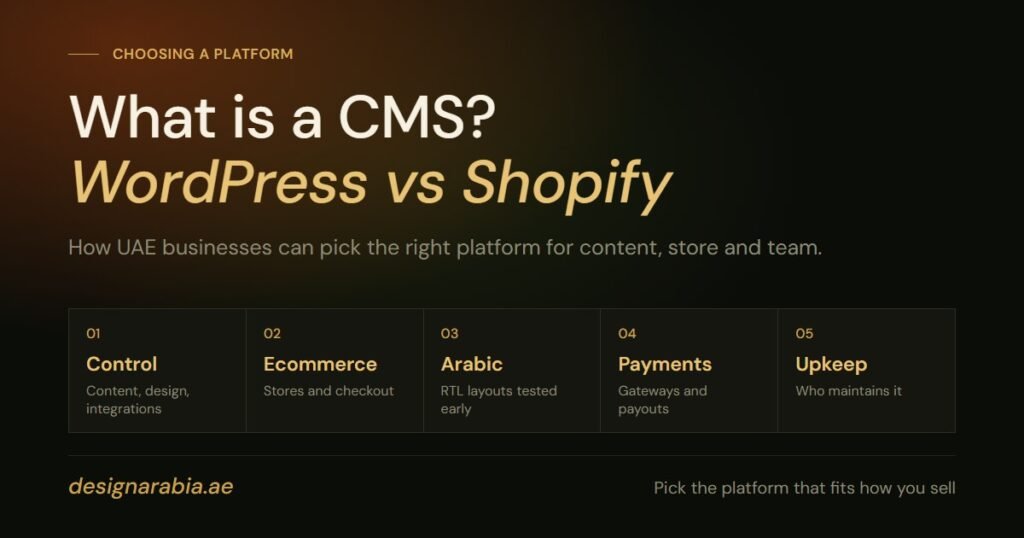
A content management system is the tool that lets your business add pages, edit text, upload images, publish blogs, and manage products without rebuilding the website each time. For UAE businesses, the right choice affects Arabic content, online payments, SEO, maintenance, and how easily the site can grow. As a WordPress-focused agency that also develops Shopify stores, we usually compare WordPress with WooCommerce and Shopify first, while Wix may suit some simple starter sites but is not the focus here.
What is a CMS, in simple terms?
A CMS, short for content management system, is the control panel behind your website. Instead of asking a developer to change every headline, image, blog post, or product description, your team logs in, makes the update, and publishes it. Think of it like the admin area of your website, where marketing, sales, and operations teams can keep the site fresh.
When someone asks what a CMS is, they are usually asking how much control they will have after launch. A good CMS should let a UAE business update English and Arabic pages, add landing pages for campaigns, manage offers, publish useful content, and support ecommerce if products or services are sold online.
Why the CMS choice matters for UAE businesses
The UAE market often brings together different languages, customer expectations, and buying habits. A company may need English and Arabic content, right-to-left page layouts for Arabic, mobile-friendly browsing, AED pricing, local or international payment options, and landing pages for seasonal campaigns. The CMS you choose should support those needs without making every small update slow or expensive.
This comparison focuses on practical fit rather than platform popularity. WordPress gives broad control and deep customization through themes and plugins, while Shopify gives a hosted ecommerce system with many store features already arranged inside one admin area. WordPress.org describes WordPress as extendable through themes and plugins, and WooCommerce is an open-source ecommerce platform built on WordPress. (WordPress.org)
WordPress and WooCommerce give control and flexibility
WordPress is often the strongest fit when a website is more than a simple online shop. If your business needs service pages, blog content, landing pages, lead forms, multilingual content, custom integrations, gated resources, or advanced SEO structures, WordPress provides room to design the site around your business process. WooCommerce adds ecommerce features on top of WordPress, so the same website can handle content and selling.
For UAE companies, that flexibility matters when the site must serve different audiences, such as English-speaking residents, Arabic-speaking customers, tourists, B2B buyers, or regional GCC traffic. WordPress also allows a development team to build custom post types, templates, checkout flows, and integrations when off-the-shelf features are not enough. WordPress documentation notes that plugins extend functionality, and developer features support custom content types and application-style use cases. (WordPress.org)
Shopify gives a focused ecommerce environment
Shopify is built for online selling, so it is usually attractive when the main goal is to launch and manage a product store with less technical administration. Hosting, checkout, products, inventory, orders, discounts, and many sales tools are managed within Shopify’s ecosystem. This can reduce day-to-day technical decisions for a business that wants a structured ecommerce platform.
Shopify is also relevant in the UAE because Shopify Payments is available for the United Arab Emirates and supports credit and debit card payments plus accelerated checkout options, subject to Shopify’s requirements. Shopify also includes SEO settings such as editable titles, meta descriptions, URLs, alt text, automatic sitemap files, robots.txt handling, canonical tags, and SSL certificates. (Shopify Help Center)
WordPress vs Shopify for UAE businesses
Many searches for “WordPress vs Shopify” are really asking the same question: should your UAE business choose a flexible website platform with ecommerce added, or a hosted ecommerce platform designed mainly for selling? The answer depends on your content needs, store complexity, language requirements, payment setup, and how much technical ownership you want.
| Factor | WordPress with WooCommerce | Shopify |
|---|---|---|
| Cost | WordPress and WooCommerce core software are open source, but you still budget for hosting, development, maintenance, premium plugins, themes, and security work. Costs vary widely because the setup can be simple or highly custom. | Shopify uses subscription plans, app costs, theme costs, and payment processing charges. Shopify notes that payment processing rates for Shopify Payments depend on the subscription plan. (Shopify Help Center) |
| Flexibility | Strong for custom layouts, service pages, SEO content hubs, complex forms, integrations, and stores that need unique logic. This is often useful for UAE businesses combining lead generation with ecommerce. | Strong for standard product selling, order management, and quick store operations. Deep customization is possible, but some changes depend on theme structure, apps, or Shopify development limits. |
| Arabic and RTL | WordPress can support Arabic and right-to-left layouts when the theme is built correctly. WordPress developer documentation notes that an RTL stylesheet is included automatically when the site language direction is right-to-left. (WordPress Developer Resources) | Shopify supports multiple languages through compatible themes and translation workflows, including Shopify’s Translate & Adapt app. RTL quality should be checked theme by theme, especially for Arabic design details. (Shopify Help Center) |
| Ecommerce features | WooCommerce supports products, carts, checkout, shipping, taxes, coupons, and extensions. It suits stores that need custom product logic or a website where content and commerce are equally important. | Shopify is highly focused on ecommerce admin tasks such as product management, orders, checkout, discounts, and sales channels. It is usually simpler for teams that want a store-first workflow. |
| Payment options | WooCommerce uses payment gateway plugins, including options such as bank transfer and cash on delivery, and many additional gateway extensions. UAE suitability depends on the selected gateway, merchant account, currency, settlement, and compliance requirements. (WooCommerce documentation) | Shopify Payments is available in the UAE, and third-party providers may also be used depending on eligibility and business needs. Gateway choice should be checked against payout currency, transaction fees, refunds, and documentation requirements. (Shopify Help Center) |
| SEO | WordPress is well suited to content-heavy SEO strategies because pages, posts, custom templates, taxonomies, metadata, internal links, and technical SEO tools can be shaped around the strategy. | Shopify includes useful built-in SEO controls and automatically handles several technical items, while apps and theme development can add more features where needed. (Shopify Help Center) |
| Maintenance | WordPress requires active care: updates, backups, plugin checks, hosting management, security monitoring, and performance reviews. The benefit is more control. | Shopify handles much of the hosted platform layer, including hosting and core infrastructure. Businesses still need to manage products, apps, themes, content, analytics, and store settings. |
Cost and ownership should be viewed over time
A low starting cost does not always mean a lower total cost. WordPress can be cost-effective for a business that wants long-term ownership and custom development, but it needs a responsible maintenance plan. The website owner has more control over hosting, data structure, code, plugins, and future changes, which can be valuable when the site becomes a serious business asset.
Shopify often gives clearer platform costs because the store runs inside a hosted subscription model. That can help teams plan, especially when they do not want to manage hosting or server-level tasks. However, app subscriptions, premium themes, custom development, and payment charges should be considered before deciding.
Arabic, RTL, and bilingual content need early planning
Arabic is not just English translated into another language. It changes reading direction, spacing, alignment, menus, buttons, forms, and sometimes the full page rhythm. For UAE businesses, Arabic and English versions should be planned at the design stage, not added as an afterthought.
On WordPress, we normally check whether the chosen theme supports RTL properly, whether the page builder outputs clean Arabic layouts, and whether multilingual tools can handle URLs, menus, metadata, and translated content. On Shopify, we test the theme, translation workflow, checkout language behavior, and any app-generated elements that appear on product pages, cart pages, or forms. In both platforms, the practical rule is simple: test real Arabic content before launch.
Payment and checkout choices affect customer trust
For ecommerce website development in the UAE, payment setup is not only a technical decision. Customers need to see familiar, secure, and convenient payment options. The business also needs to understand onboarding documents, settlement timing, refund handling, chargebacks, transaction costs, and whether the payment provider supports the required currencies and business model.
WooCommerce gives more freedom to integrate gateways through plugins or custom development, which is helpful when a business has specific banking, cash on delivery, invoice payment, or B2B checkout needs. Shopify can be simpler when Shopify Payments or supported third-party providers match the business requirements. In both cases, payment decisions should be confirmed before design and development go too far.
SEO depends on content strategy as much as platform
WordPress is often our first recommendation for businesses that depend on search visibility through service pages, educational articles, local landing pages, comparison pages, and detailed resources. It gives broad control over site structure and content design, which can support long-term organic growth when paired with good writing, technical SEO, and consistent publishing.
Shopify can also perform well for ecommerce SEO, especially when product pages, collection pages, metadata, image alt text, internal links, and page speed are handled carefully. Shopify’s own guidance emphasizes keywords in page titles, meta descriptions, alt tags, and body content, along with relevant content and links. (Shopify Help Center)
Which platform should your UAE business choose?
Choose WordPress with WooCommerce if your website needs strong content, custom design, bilingual flexibility, advanced SEO structures, and ecommerce that can be shaped around your business. Choose Shopify if your main priority is a product store with a managed ecommerce admin, quicker operational setup, and less responsibility for hosting and platform maintenance.
A practical choice often looks like this:
- Choose WordPress with WooCommerce when you need a corporate website plus ecommerce, custom quote requests, complex service pages, Arabic and English content depth, or integration flexibility.
- Choose Shopify when you sell a clear product catalog, want a store-first admin experience, and prefer a hosted platform that handles much of the technical environment.
- Choose either platform only after checking payment eligibility, Arabic layout quality, SEO requirements, app or plugin costs, and who will maintain the site after launch.
A simple decision checklist before you build
Before committing to a CMS, answer these questions with your team:
- Will the website mainly generate leads, sell products, publish content, or do all three?
- Do you need Arabic, English, or both from day one?
- Will Arabic pages need full right-to-left design, not just translated text?
- Which payment methods and settlement currencies does your UAE business require?
- Who will update products, blogs, banners, and landing pages after launch?
- Do you need custom checkout rules, B2B pricing, booking flows, or integrations?
- Is long-term SEO a major channel for your business?
- Do you have a maintenance budget for updates, backups, testing, and improvements? See our guide to website maintenance services and costs.
If the answers point toward content depth and flexibility, WordPress is usually the better base. If they point toward straightforward retail operations, Shopify may be the cleaner choice.
Final takeaway
The best CMS is the one that fits how your UAE business sells, communicates, and grows. WordPress with WooCommerce gives more control and customization, while Shopify gives a focused hosted ecommerce experience. Both can work well when the strategy, Arabic support, payments, SEO, and maintenance plan are handled properly.
If you want help choosing or building the right platform, explore our WordPress development services or our ecommerce website development services. If you are building a store, our guide on how to choose an ecommerce website development company is a useful next read, and our website cost guide explains what drives pricing. We can review your business goals, compare WordPress and Shopify for your use case, and recommend a practical build plan before development begins.