
Property buyers and tenants now start their search online, often on a phone, and often in more than one language. That makes the choice of marketing partner one of the more important decisions a brokerage, agent or developer makes. The right team fills your pipeline with serious enquiries. The wrong one burns budget on clicks that never turn into viewings.
If you have searched for the best real estate marketing companies in the UAE, you will have found plenty of polished pitches. How do you tell real expertise from empty claims? This guide sets out what to look for in a real estate marketing company in the UAE, what to ask before you sign, and which warning signs to take seriously.
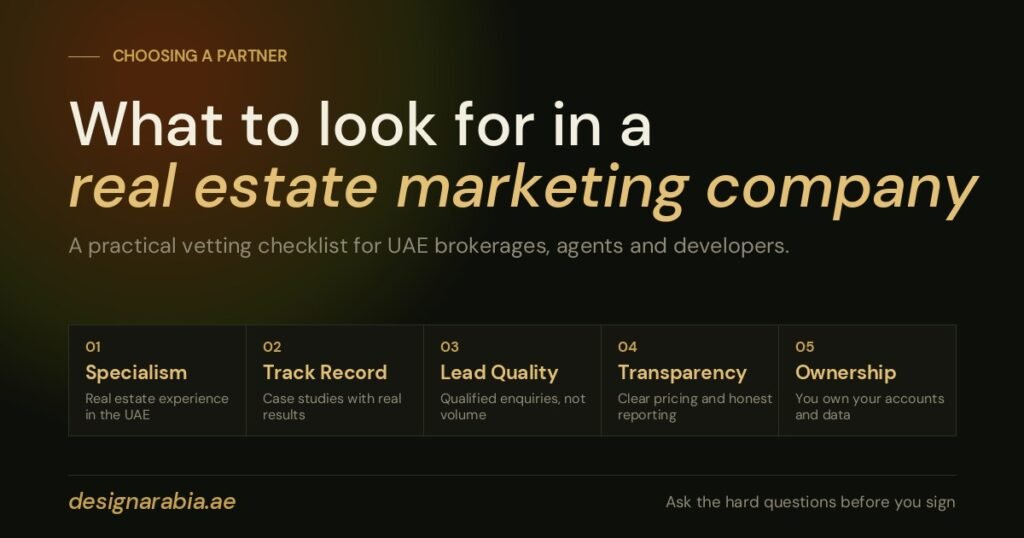
The vetting checklist at a glance
- Specialism: proven experience in real estate, and in the UAE market specifically
- Track record: case studies that show results, not just attractive work
- Lead quality: a focus on qualified enquiries over cheap volume
- Technology: CRM integration and fast follow-up
- Transparency: clear pricing and reporting tied to business outcomes
- Ownership: you own your website, ad accounts and data
Why a specialist matters
A specialist real estate digital marketing company understands the property cycle from launch to handover. A generic agency that markets restaurants, clinics and online shops will treat property like any other product. But real estate has long sales cycles, high-value emotional decisions, strict advertising rules and sharply local audiences. A specialist understands the difference between a casual browser and a serious buyer, and knows how to nurture the second one.
They also know that marketing an off-plan launch is not the same as marketing a ready villa, a luxury penthouse, a rental or a commercial unit. The audience, message, channels and timeline all change. If you want to see how a focused approach looks, read about our real estate marketing services.
Check the track record and portfolio
Do not take an agency’s word for it. Ask for proof, and look for variety, quality and results.
- Do their own and their clients’ websites load quickly and work well on mobile?
- Are the ads visually polished and clear about the offer?
- Is the copy persuasive and accurate, and does it respect advertising rules?
Then ask for case studies that tell the whole story: the starting problem, the strategy, the work and the outcome, such as more qualified leads, more viewings or lower cost per lead. Look for cases that match your goal, whether that is launching a project, recruiting agents, entering the luxury segment or growing listing volume. You can see an example of how we document results in our real estate SEO and Google Ads case study.
Full-service or boutique?
- Full-service agencies are usually larger and offer SEO, paid ads, web design, content and PR under one roof. They suit companies that want to outsource most of their marketing department.
- Boutique agencies are smaller, more specialised and often more personal. You may work directly with senior people, and they can move quickly. They suit teams that want a close working relationship.
Neither is automatically better. Choose based on your budget, how much management time you can give and how much specialist depth you need.
Lead quality over lead volume
Impressions and likes do not pay the bills. The core of any good partnership is a strategy for qualified enquiries.
Beware of agencies that boast about hundreds of cheap leads. Broad social campaigns often produce contacts with wrong numbers, no budget or only passing curiosity, and your team’s time is too valuable to spend on them. A strong partner improves lead quality through precise audience targeting, qualifying questions on forms, and ad copy that naturally filters out the wrong people. They balance intent-led channels such as search ads, where people are already looking, with social ads that build awareness. Our guide to digital marketing for real estate agents shows how those channels fit together.
Technology, CRM and follow-up speed
Generating the lead is only step one. Responding faster than your competitors is step two. Ask about their experience with automation: instant WhatsApp and email replies, follow-up sequences and retargeting ads.
Check how they connect campaigns to your CRM. Whichever system you use, every lead should arrive tagged with its source, assigned to the right person and entered into the right follow-up flow automatically. If leads sit in an inbox or spreadsheet for hours, even a great campaign underperforms.
Core services a good partner should cover
Strong visuals and advertising
Property is a visual business. Buyers react to images first, so make sure the agency either produces or coordinates professional photography, video tours, drone footage and 3D or virtual tours. For luxury and off-plan projects, polish matters even more. Standard templates will not do, and the agency should know how to present exclusivity and build trust, from creative to channel selection. Our creative real estate marketing ideas show what that can look like.
Content, SEO and social media
A sustainable plan does not depend only on paid ads. Look for an agency that can build organic visibility over time:
- Content: community guides, market updates and buyer or investor explainers that establish you as a local authority.
- Search: optimised project and area pages, plus a well-managed Google Business Profile for local discovery.
- Social: useful short videos, walkthroughs and carousels that build trust before anyone enquires, not just “just listed” posters. See social media marketing for real estate companies.
Local market knowledge
In the UAE, a good partner understands bilingual audiences, the major property portals, WhatsApp as a primary enquiry channel and the rules around property advertising. Ask how they handle advertising permits and how they keep your listings and claims accurate.
Transparent pricing and budgeting
Marketing is an investment, but it should never feel like a black hole. A trustworthy agency is open about what you pay and why.
Common pricing models
- Monthly retainer: a fixed fee for a defined set of deliverables, such as ad management, content and SEO. This is the most common and the most predictable.
- Project-based fee: suited to one-off work like a new website, brand identity or CRM setup.
- Percentage of ad spend: a management fee calculated on your ad budget. The percentage varies by agency and by spend, so ask for the exact terms.
Budget allocation
A real partner advises you on how to split the budget, not just takes it. Typically that means some for immediate lead generation through search and social ads, some for longer-term growth through SEO and content, and some for awareness and retargeting. They should help you adjust as your results and commission income grow. Our guide on how to hire a digital marketing agency in the UAE covers contracts and budgets in more detail.
Proving success: analytics and ROI
The test of any agency is whether it can prove its value with data. If reports only show impressions and clicks, treat that as a warning sign. Ask for reporting on the numbers that reach your bottom line:
- Cost per lead: what it costs to get one enquiry.
- Lead quality: how many enquiries are genuine and within budget.
- Lead-to-viewing ratio: how many leads turn into viewings or consultations.
- Cost per acquisition: what marketing spend it takes to close a deal.
- Website conversion rate: how many visitors fill in a form, call or message you.
A good agency schedules regular reviews, monthly or quarterly, to explain what is working, what is not and what changes next.
Red flags to avoid
- Guaranteed rankings or leads. No agency can promise a specific position on Google or a set number of sales. Look for a proven process, not an impossible guarantee.
- No real estate experience. If their work is all in unrelated industries, they may struggle with project launches, portals and advertising rules.
- You do not own your assets. Your contract should say you own your website, domain, ad accounts and lead data. Some agencies hold these back when a client leaves.
- Poor communication. If they are slow while trying to win your business, expect worse once they have it.
- Vague answers about cost and reporting. Transparency should start in the first meeting.
Practical tips for choosing
- Research them independently. If an agency claims to be an SEO expert but is hard to find online, ask why.
- Ask for an audit. Many agencies offer a free or low-cost review of your current digital presence, which shows how they think.
- Meet the people doing the work. The salesperson may be excellent, but who will run your account day to day?
- Look at their own marketing. An agency that neglects its own brand may neglect yours.
- Start with a pilot. A short, defined project, such as one Google Ads campaign, lets you test fit before committing to a long retainer.
If you are still working out what you need, our guide to property marketing services explains what a full campaign includes.
Final thoughts
Choosing a marketing partner is one of the most consequential decisions a real estate business makes. The right agency acts as an extension of your team, filling your calendar with qualified viewings while you focus on relationships and closing deals. Take your time, ask for case studies, insist on transparent pricing and honest reporting, and choose the team that is as committed to your growth as you are. When you are ready to talk, you can request a free quote.