
The UAE is home to one of the most connected, digitally advanced economies in the world, with internet penetration above 99% and residents spending an average of around eight hours a day online. That makes the market a genuine opportunity for businesses, but capitalising on it takes more than running a few Facebook ads or publishing the occasional blog post. It takes a data-driven, culturally aware approach.
If you run a business in this region, you already know the competition is fierce. Standing out takes real expertise, but the market is flooded with agencies, from global networks with offices in Dubai Media City to boutique firms running out of free zones. How do you cut through the noise and find a partner who genuinely understands your business?
This guide walks through the full process, from defining your goals to spotting red flags in a proposal, so hiring a digital marketing agency in the UAE takes days, not months, and protects your budget along the way.
Step 1: Assess Your Needs Before You Start Looking
Before you Google a single agency, look inward first. The most common mistake businesses make is approaching an agency with vague goals like “we want more sales” or “we need to go viral.” A good partnership starts with internal clarity.
Define Your Objectives and Budget
Are you after brand awareness, lead generation, app installs or ecommerce sales? Your goal shapes the type of agency you need. A firm that specialises in SEO may not be the right fit if your priority is viral TikTok content. Set your budget too: digital marketing in the UAE can range from a few thousand dirhams a month to multi-million-dirham campaigns, and knowing your ceiling helps you shortlist faster.
In-House vs Outsourcing
One of the first decisions you will face is building an internal team versus outsourcing. An in-house team gives you full control and 100% of your employees’ attention, but the cost of hiring a full team in the UAE, including recruitment, visas, health insurance, end-of-service benefits and software, adds up quickly. You would need an SEO specialist, a copywriter, a designer, a performance marketer and a social media manager just to cover the basics.
Outsourcing to an agency gives you access to that same range of specialised talent at a fraction of the cost, plus cross-industry insight and tools you would not otherwise have. For most growing UAE SMEs, the agency route delivers a meaningfully better return on investment.
Step 2: Understand the UAE Digital Landscape
Marketing in the Middle East is not a copy-and-paste job from Western playbooks. The UAE is home to over 200 nationalities, and an agency needs to genuinely understand that mix.
GCC Consumer Behaviour
A capable agency has a firm grip on how GCC consumers actually behave. Smartphone penetration is among the highest globally, which makes mobile-first marketing non-negotiable. Social consumption skews heavily toward TikTok, Snapchat and Instagram. The region also has distinct shopping seasons, Ramadan, Eid and White Friday among them, that require campaigns planned months in advance. Your agency should be able to speak clearly to when, where and how UAE consumers actually buy.
Arabic Localisation Matters
If there is one non-negotiable trait, it is genuine skill in Arabic content localisation. Many international brands stumble in the Middle East because they rely on literal translation, or worse, machine translation, which loses cultural context and tone. A good agency understands the difference between Modern Standard Arabic for formal corporate communication and local Khaleeji dialects for social content, and makes sure visuals align with regional cultural sensitivities too.
Step 3: Choose the Right Type of Agency
Agencies come in different shapes, and the right choice depends on aligning their model with your goals.
Boutique vs Full-Service Agencies
- Large full-service agencies are often part of global networks or major regional players, offering PR, media buying, creative, SEO and events under one roof. They suit enterprise clients running complex, multi-channel national campaigns, though smaller clients can end up handed to a junior account manager.
- Boutique agencies are smaller and more specialised, often focused on one or two disciplines like performance marketing or SEO. Service tends to be more hands-on, sometimes with the founders directly involved in strategy. For most mid-sized businesses, a boutique agency offers the agility and attention that moves the needle.
Startups and Niche Needs
A new venture needs a partner comfortable with the fast, pivot-heavy nature of early-stage growth: lean testing, aggressive customer acquisition, and experience navigating funding rounds. If you are a homegrown UAE brand planning to expand into Saudi Arabia or the wider GCC, look for an agency with a track record of scaling local businesses across those borders.
Step 4: Build and Vet Your Shortlist
Once you know what you need, build a shortlist of three to five agencies and start vetting.
Check Their Own Digital Footprint
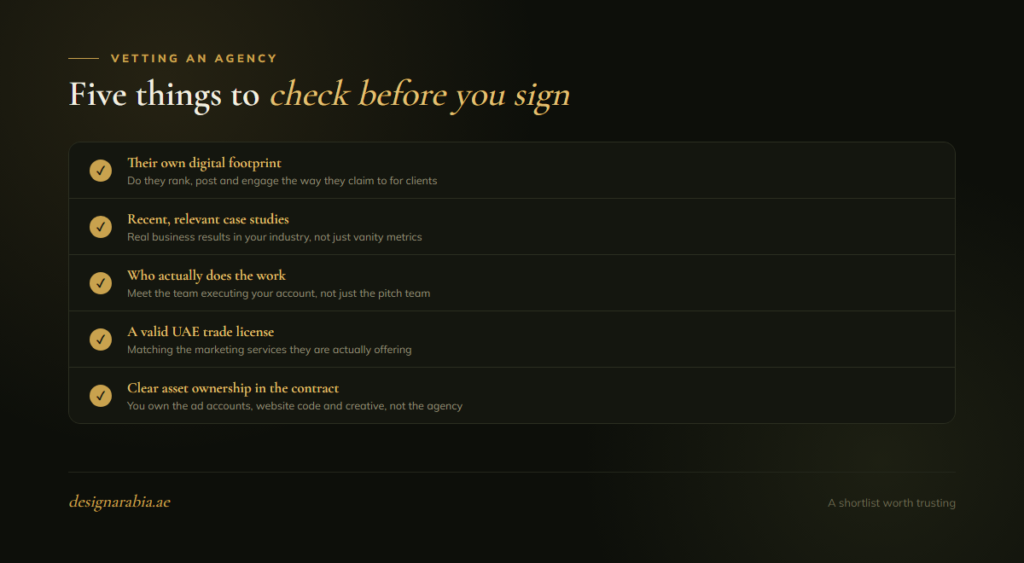
Start by looking at how an agency markets itself. If they claim SEO expertise but do not rank for basic terms in their own niche, that is a red flag. If they pitch social media management but their own Instagram or LinkedIn has been dormant for months, be cautious.
Do not limit your search to Dubai either. If your audience includes government entities or heavy industry, agencies based in Abu Dhabi may have a stronger grasp of B2G work and corporate communications.
Review Their Case Studies Properly
Never hire based on a slick pitch deck alone. When you review case studies, look past the graphics and ask:
- Did they solve a problem similar to yours?
- Do they have experience in your industry, such as real estate, healthcare or F&B?
- Are the case studies recent?
- Do they show real business results, revenue, leads, cost per acquisition, rather than vanity metrics like likes or impressions?
Step 5: Ask the Right Questions at Interview
Once you have a shortlist, invite agencies in for a pitch or discovery call. This is where you separate a good hire from an expensive mistake.
- Who will manage my account day to day? Agencies often bring senior directors to the pitch and hand the account to a junior executive once the contract is signed. Ask to meet the actual team.
- How do you handle localisation? Ask them to walk through a time they successfully localised an English campaign for the Arabic-speaking GCC market.
- What happens if a campaign underperforms? You want an agency that is honest about failure and has a clear process for pivoting when a test does not deliver.
- How do you report on success? A competent agency talks about KPIs tied to your bottom line. For ecommerce, that means customer acquisition cost, return on ad spend and lifetime value. For B2B, cost per lead and lead-to-close ratio.
- Do you outsource the work? Some UAE agencies act as white-label middlemen, outsourcing execution to freelancers abroad. That is not automatically a problem if quality control is tight, but you deserve to know where your data and brand assets are going.
Step 6: Understand Pricing and Contracts
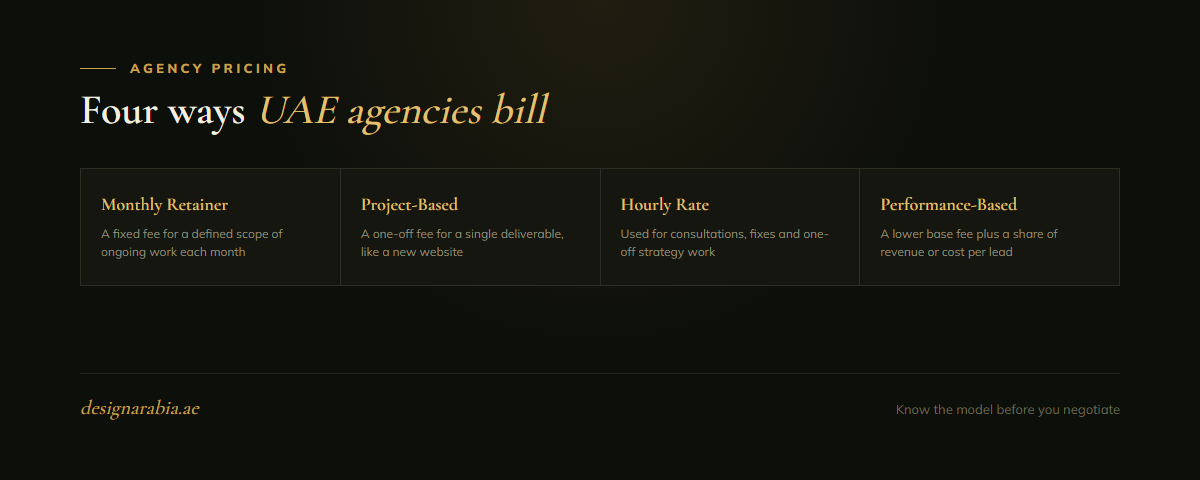
Money is usually the most complicated part of the relationship, so it helps to understand the standard structures first.
- Monthly retainer: a fixed fee for a defined scope, such as four blog posts, fifteen social posts, ongoing SEO and daily ad management. Predictable for both sides.
- Project-based pricing: a one-off fee for a specific deliverable, like a new website or a brand identity project.
- Hourly rates: common for consultations, technical fixes, or PR crisis management.
- Performance-based pricing: gaining ground in ecommerce and real estate, where the agency takes a lower base fee plus a share of revenue or a fee per qualified lead.
If you go the performance route, make sure the contract defines exactly what counts as a “qualified lead” so you are not paying for spam or irrelevant enquiries, and agree on the attribution model upfront. Always look for a reasonable exit clause too. In a market that moves as fast as the UAE, being locked into a rigid twelve-month contract with an underperforming agency can genuinely hurt a business. A thirty or sixty-day notice period after an initial three-month trial is a fair standard to ask for.
Step 7: Do Your Due Diligence
The last step before signing is protecting yourself legally and financially.
Check the Trade License
Every legitimate business in the UAE needs a valid trade license from the relevant Department of Economic Development or a free zone authority such as DMCC, Dubai Internet City or Shams. Some people operate as “agencies” on tourist visas or unrelated freelance permits, and if a dispute arises over IP, a breached contract or unreturned ad spend, taking action against an unlicensed entity is genuinely difficult. Ask for a copy of the trade license and check that the listed business activity actually matches the services being offered.
Spot the Red Flags in a Proposal
- Guaranteed results. If anyone guarantees the number one ranking on Google in 30 days, or an exact follower count, treat it as a warning sign. Search algorithms are not something any agency controls. A credible partner promises solid practices and data-driven effort, not fixed numerical outcomes.
- Vague deliverables. “Improving social media presence” is a red flag. “Twelve original, graphic-designed Instagram posts a month across feed and stories, with community management from 9am to 6pm” is a real deliverable.
- Unclear asset ownership. Your contract should state plainly that you own everything created: the Google Ads account, the Meta Business Manager, the website code, the creative assets. Some agencies try to retain control of ad accounts to make it harder for a client to leave.
- No competitor research. A strong proposal includes a preliminary audit of your UAE competitors. If an agency has not looked at what your direct rivals in Dubai or Abu Dhabi are doing, they have not done the groundwork.
Setting Up for Long-Term Success
Signing the contract is the beginning, not the end. Getting real value from an agency means treating them as an extension of your team rather than an external vendor. Schedule weekly status calls and monthly strategy sessions, and share your actual sales data with them. If an agency does not know which leads are converting into paying customers, they cannot optimise your campaigns properly.
Final Thoughts
Finding the right digital partner in a fast-moving, culturally diverse market like the UAE is a real strategic decision. By getting clear on your internal goals, understanding the local consumer landscape, and vetting candidates properly, you can navigate the process with confidence.
The goal is not just finding someone who can run ads. It is finding a partner who understands your business, respects Arabic localisation, tracks metrics that actually matter, and operates with full transparency about where your budget goes.