
Search engine optimisation, usually shortened to SEO, is the practice of improving a website so search engines can discover it, understand it, and show it to the right people when they search. In digital marketing, SEO is the channel that connects your pages with existing demand: people are already asking questions, comparing options, looking for services, or trying to solve a problem. Your job is to make your content the most useful, accessible, and trustworthy answer available.
Put simply, SEO is not about “tricking” Google. Modern SEO is about making your website easier for both people and search engines to use. Google’s own SEO guidance describes SEO as work that helps search engines crawl, index, and understand content, while also improving a site’s presence in Search.
Quick answer: what SEO means
SEO stands for search engine optimisation. It includes the content, technical, and authority-building work that helps web pages appear in unpaid search results.
If you are asking “what is SEO in digital marketing”, the answer is: SEO is the organic search part of a digital marketing strategy. It helps businesses attract relevant visitors from search engines without paying for each click. Unlike paid ads, SEO usually takes longer to build, but strong SEO can keep bringing traffic, leads, and sales over time.
A helpful way to think about SEO is this:
- Search engines want to return useful, relevant results.
- Searchers want fast, trustworthy answers.
- Businesses want to be found by people who are likely to become customers.
- SEO aligns all three by improving the quality, clarity, accessibility, and credibility of your website.
SEO can support many marketing goals, including brand awareness, lead generation, ecommerce sales, local enquiries, customer education, and retention. A blog post might help someone discover your brand for the first time. A service page might persuade them to request a quote. A product category page might help them compare options and buy.
Why SEO matters in digital marketing
SEO matters because search is intent-driven. Someone typing “best running shoes for flat feet,” “emergency plumber near me,” or “how to reduce software onboarding time” is revealing a need. That need may be informational, commercial, local, or transactional. SEO helps you appear at the moment that need is being expressed.
Compared with many interruption-based marketing channels, organic search often reaches people when they are actively looking. That makes SEO especially valuable for:
- Capturing demand from people already searching for your topic, product, or service.
- Building trust through helpful content before someone is ready to buy.
- Reducing reliance on paid media by earning unpaid visibility.
- Improving conversion paths by making pages clearer, faster, and easier to navigate.
- Supporting other channels because strong SEO content can also be used in email, social media, sales enablement, and paid campaigns.
SEO is also compounding. A paid campaign generally stops producing traffic when the budget stops. A useful, well-maintained page can keep attracting visitors long after it is published. That does not make SEO “free” because it requires strategy, content, technical work, and maintenance, but it does make it one of the most durable digital marketing investments.
How search engines actually work
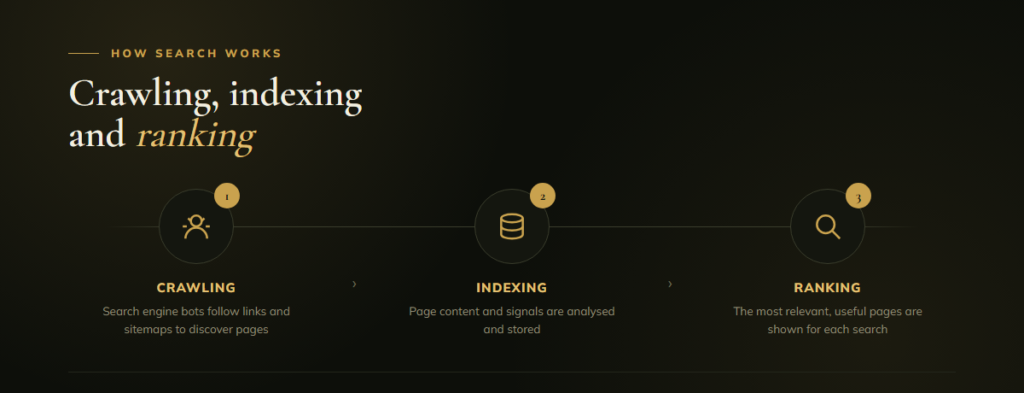
Search engines use automated systems to discover pages, store information about them, and return results when someone searches. Google describes its Search process in three broad stages: crawling, indexing, and serving search results. Crawling is when automated programs discover and download pages; indexing is when Google analyses page content and stores information; serving is when Google returns results that match a user’s query.
1. Crawling: finding pages
Crawling is discovery. Search engine bots follow links from known pages to new pages. They may also use sitemaps, which are files that list important URLs on a site. If a page cannot be reached through internal links, has broken server responses, is blocked incorrectly, or depends on content that bots cannot access, it may not be discovered or understood properly.
For example, imagine you publish a new service page for “commercial HVAC maintenance.” If that page is linked from your services menu, included in your sitemap, and loads normally, search engines have a clearer path to find it. If it is orphaned with no internal links, discovery may be slower or less reliable.
2. Indexing: understanding pages
Indexing is the process of analysing a page and storing information about it. Search engines look at visible text, titles, headings, images, videos, metadata, canonical signals, language, and other signals to understand what the page is about. Google notes that indexing is not guaranteed, and some pages may not be indexed because of low content quality, robots meta rules, duplication, or technical barriers.
This is why SEO is not just about publishing. A page must be accessible, unique enough to deserve indexing, and clear enough for search engines to interpret.
3. Ranking and serving: choosing results
When someone searches, the search engine looks through its index and returns results it believes are relevant and useful. Google says its ranking systems use many factors and signals across huge numbers of pages to present relevant, useful results quickly. These systems work largely at page level, although site-wide signals can also contribute to how pages are understood.
Ranking is not a simple checklist where one factor guarantees position one. The “best” result depends on the query, user intent, location, language, device, freshness needs, page quality, and the available competition. A page that ranks well for “how to clean suede shoes” may not rank for “buy suede shoes,” because those searches imply different intent.
The main types of SEO
SEO is usually divided into several connected areas. You do not need to master all of them on day one, but you do need to understand how they work together.
Technical SEO
Technical SEO makes sure your website can be crawled, indexed, rendered, and used efficiently. It covers site architecture, internal linking, page speed, mobile usability, structured data, redirects, canonical tags, robots directives, XML sitemaps, security, and accessibility basics.
Technical SEO is the foundation. If search engines cannot access a page, the quality of the writing will not matter. If users abandon a page because it is slow or broken on mobile, rankings and conversions can both suffer.
On-page SEO
On-page SEO improves individual pages. It includes keyword targeting, headings, title tags, meta descriptions, URLs, body copy, internal links, image alt text, and content structure.
Good on-page SEO is not keyword stuffing. It is clarity. A well-optimised page makes it obvious what the page is about, who it helps, what questions it answers, and what action the reader can take next.
Content SEO
Content SEO focuses on planning, creating, and improving content that satisfies search intent. This includes blog posts, guides, product pages, service pages, category pages, comparison pages, case studies, FAQs, and resource hubs.
Strong SEO content usually has a clear audience, a clear purpose, original value, useful examples, and enough depth to help the reader complete their task. Good copywriting is what turns that structure into something people actually want to read.
Off-page SEO
Off-page SEO includes signals that happen away from your website, especially links and mentions from other sites. Links can help search engines discover pages and understand authority or relevance. However, the quality and context of links matter far more than sheer quantity.
Ethical off-page SEO is usually built through digital PR, partnerships, useful resources, original research, community participation, and content worth referencing.
Local SEO
Local SEO helps businesses appear for location-based searches such as “dentist near me” or “family lawyer in Chicago.” It includes location pages, Google Business Profile optimisation, local citations, reviews, local content, and consistent name, address, and phone information.
For businesses with physical locations or service areas, local SEO can be one of the highest-intent marketing channels.
Search intent: the heart of modern SEO
Search intent is the reason behind a query. If you understand intent, you can create the right type of page. If you ignore intent, even a technically optimised page can fail.
Most searches fit into one or more of these intent types:
- Informational: The user wants to learn something. Example: “what is SEO.”
- Commercial: The user is comparing options. Example: “best SEO tools for small business.”
- Transactional: The user is ready to act. Example: “buy SEO audit template.”
- Navigational: The user wants a specific brand or page. Example: “Google Search Console login.”
- Local: The user wants a nearby result. Example: “SEO agency near me.”
For the query “what is SEO,” the searcher is usually a beginner who wants a clear definition, simple explanation, examples, and next steps. A page targeting that query should not start with advanced technical jargon. It should explain SEO in plain language first, then gradually introduce crawling, indexing, ranking, content, technical SEO, and measurement.
Practical example of intent
Suppose you run a meal delivery company. These searches need different pages:
- “What is meal prep?” needs an educational guide.
- “Meal prep vs meal delivery” needs a comparison article.
- “Healthy meal delivery in Austin” needs a local landing page.
- “High protein meal plan delivery” needs a product or category page.
- “Meal delivery pricing” needs a pricing or plans page.
Trying to rank one generic page for all of those searches would make the page unfocused. SEO works better when each important intent has a dedicated, useful page.
Keywords still matter, but not the way they used to
Keywords are the words and phrases people use when searching. They still matter because they reveal demand, language, and intent. However, modern SEO is not about repeating one phrase as many times as possible.
A good keyword strategy considers:
- The main topic of the page.
- The search intent behind the query.
- Related questions and subtopics.
- The reader’s level of awareness.
- The business value of the traffic.
- The type of page that currently satisfies the query.
For example, a page about “SEO for dentists” might naturally mention dental marketing, local SEO, Google Business Profile, patient reviews, appointment requests, service pages, and location pages. These related terms help create a complete, useful resource.
The best practice is to use keywords naturally in prominent places such as the page title, main heading, introduction, subheadings where relevant, body copy, image alt text when descriptive, and internal link anchor text. Google’s Search Essentials recommends using words people would use to look for your content in prominent locations, while also focusing on helpful, reliable, people-first content.
On-page SEO best practices
On-page SEO turns a useful idea into a page that searchers and search engines can understand.
Write clear title tags
A title tag is often a major source for the clickable title shown in search results. It should be descriptive, concise, unique, and aligned with the page. Google recommends giving every page a title, avoiding vague or overly long titles, and avoiding keyword stuffing.
A weak title might be:
- “Services”
A stronger title would be:
- “Small Business Accounting Services in Denver”
The stronger version tells users what the page is about, who it is for, and where it is relevant.
Use headings to structure the page
Headings help readers scan and help search engines understand the organisation of the content. A good heading structure should feel like an outline. Each section should answer a specific question or develop a specific idea.
For example, a beginner SEO guide might use sections such as:
- What SEO means.
- How search engines work.
- Why SEO matters in digital marketing.
- Types of SEO.
- How to measure SEO.
- Common SEO mistakes.
Write useful meta descriptions
A meta description does not guarantee a specific snippet, but it can help summarise the page. Google says snippets are automatically created from page content and may vary by search, but the meta description can be used when it provides a more accurate description than the page content alone.
A good meta description should read like a short pitch for the page. It should explain the benefit of clicking without exaggerating or promising something the page does not deliver.
Create descriptive URLs
Readable URLs help users understand where they are and what a page is about. A URL like /seo-guide/ is clearer than /page?id=8472/. Keep URLs short, descriptive, and consistent. Avoid changing URLs unnecessarily, because changes often require redirects and can create maintenance issues.
Use internal links intentionally
Internal links connect related pages on your site. They help users continue their journey and help search engines discover and understand your content. Google states that links help it find new pages and that anchor text helps both people and Google make sense of linked content.
Instead of linking with vague text like “click here,” use descriptive anchor text such as “local SEO checklist” or “technical SEO audit guide.” The anchor should match the destination page naturally.
Optimise images for context and accessibility
Images can improve engagement and understanding, but they should support the content. Use descriptive filenames when practical, compress images for performance, and write alt text that describes the image for users who cannot see it. Do not stuff alt text with keywords.
Good alt text:
- “Screenshot of a Google Search Console performance report showing clicks and impressions.”
Poor alt text:
- “SEO SEO search engine optimization best SEO services.”
Helpful content and E-E-A-T
Google’s guidance consistently points toward helpful, reliable, people-first content. Its documentation says automated ranking systems are designed to prioritise helpful information created to benefit people, not content made primarily to manipulate search rankings.
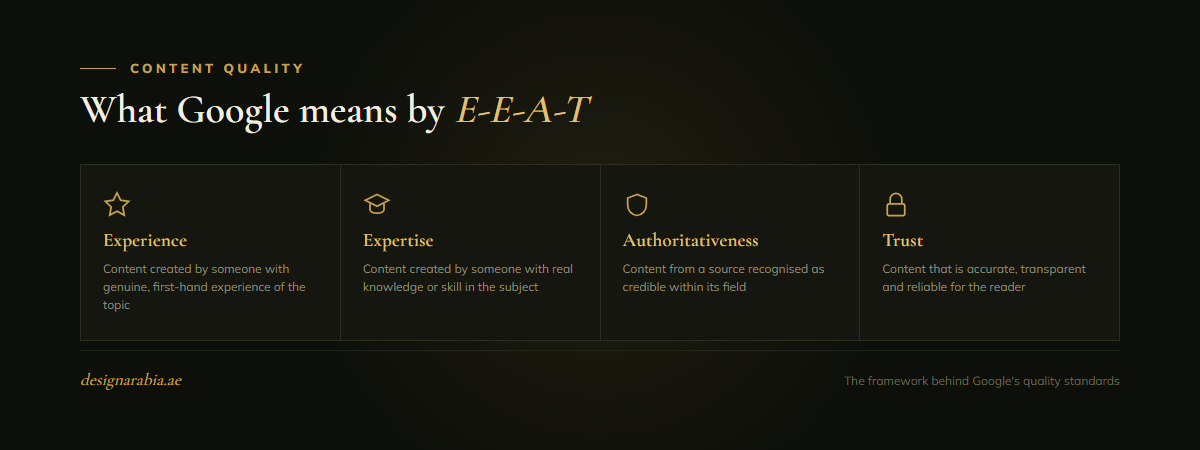
E-E-A-T stands for experience, expertise, authoritativeness, and trustworthiness. It is not a single score you can add to a page, but it is a useful framework for content quality. Google explains that trust is especially important, and that its systems use a mix of factors to identify content that demonstrates strong E-E-A-T, especially for topics that can affect health, finances, safety, or wellbeing.
To make content more helpful, ask:
- Who is this page for?
- What problem does it solve?
- Does it add anything beyond what is already ranking?
- Does it include first-hand experience, examples, data, or expert insight?
- Would a reader feel satisfied after reading it?
- Is the author or brand credible on this topic?
- Is the content accurate, current, and easy to verify?
For example, a generic article titled “Best CRM Software” that only rewrites vendor descriptions is weak. A stronger article might include hands-on testing notes, use-case recommendations, screenshots, selection criteria, limitations, and clear disclosures about affiliate relationships.
Technical SEO basics beginners should understand
Technical SEO can sound intimidating, but the fundamentals are straightforward.
Make important pages crawlable
Your most important pages should be linked from navigation, category pages, related content, or other relevant internal pages. Avoid hiding important pages behind search forms, scripts, or filters that create crawl problems.
Make important pages indexable
If you want a page to appear in search, do not accidentally block it with a noindex directive, robots rules, password protection, or canonical tags pointing somewhere else. These tools are useful when applied correctly, but harmful when applied accidentally.
Improve page experience
Page experience includes whether a page is usable, accessible, secure, and pleasant to interact with. Google’s helpful content documentation advises site owners not to focus on only one or two page experience aspects, but to provide a strong overall experience across many aspects.
Practical improvements include:
- Fast loading on mobile and desktop.
- Stable layouts that do not jump around as content loads.
- Readable fonts and adequate spacing.
- Clear navigation.
- Secure HTTPS pages.
- Minimal intrusive popups.
- Accessible design for users with disabilities.
If your current site is struggling on several of these points at once, a full website redesign is often faster than patching individual issues.
Use structured data where it genuinely fits
Structured data is code that helps search engines understand specific information on a page, such as products, recipes, reviews, events, FAQs, organisations, or breadcrumbs. It is not a ranking shortcut. Use it only when it accurately represents visible page content and matches the relevant guidelines.
Fix broken links and redirects
Broken links waste user time and can make a site feel neglected. Redirects are normal when pages move, but long redirect chains and incorrect redirects can create confusion. Keep your site clean by regularly checking for 404 errors, outdated links, and redirect issues.
Authority, links, and reputation
Search engines use links as one way to discover pages and evaluate relevance. But link building has changed. The goal is not to collect as many links as possible from any source. The goal is to earn relevant references from credible places.
Good reasons a site might link to you include:
- You published original research.
- You created a useful tool or calculator.
- You provided a clear explanation of a complex topic.
- You contributed expert commentary.
- You built a resource worth citing.
- You have a strong brand or product people discuss naturally.
Risky link tactics include buying manipulative links, participating in link schemes, using private blog networks, or creating low-quality guest posts at scale. Google’s spam policies define spam as tactics intended to deceive users or manipulate Search systems, and sites that violate policies may rank lower or not appear in results.
A sustainable approach to authority combines great content, genuine relationships, PR, partnerships, community involvement, and brand building.
SEO and AI search: what has changed?
Search results are no longer just a list of blue links. They can include featured snippets, videos, images, shopping results, local packs, “People also ask” boxes, knowledge panels, and AI-generated search experiences.
That does not mean SEO is dead. Google’s guidance for generative AI features says foundational SEO best practices continue to matter because these AI experiences are rooted in Google’s core Search ranking and quality systems. It also advises focusing on unique, valuable, people-first content rather than chasing “AEO” or “GEO” hacks.
For modern SEO, this means your content should be:
- Clear enough to answer specific questions.
- Deep enough to provide value beyond a short summary.
- Original enough to be worth citing or visiting.
- Structured enough for readers to scan.
- Trustworthy enough for sensitive or high-stakes topics.
- Supported by real experience, data, examples, or expertise.
AI search makes mediocre content less useful. If an AI result can summarise the same generic advice, users need a stronger reason to click. That reason might be a tool, template, comparison, case study, original image, expert explanation, product detail, or first-hand review.
How to measure SEO performance
SEO measurement should connect visibility to business outcomes. Rankings are useful, but they are not the whole story.
Google Search Console’s Performance report shows important search metrics, including clicks, impressions, click-through rate, average position, queries, pages, countries, devices, and search appearance data.
Key SEO metrics include:
- Organic clicks: How many people visit from unpaid search results.
- Impressions: How often your pages appear in search results.
- Click-through rate: The percentage of impressions that become clicks.
- Average position: The average ranking position of your result.
- Indexed pages: Which important pages are included in the index.
- Conversions: Leads, purchases, bookings, signups, calls, or other meaningful actions.
- Engagement: Time on page, scroll depth, return visits, or assisted conversions.
- Revenue or pipeline: The commercial value generated by organic search.
Do not judge SEO only by one keyword. A healthy SEO strategy usually earns visibility across many related queries. One page may rank for dozens, hundreds, or even thousands of variations over time.
A practical SEO example
Imagine a small accounting firm wants more clients from organic search. Here is how SEO might work in practice.
First, the firm identifies its most valuable services:
- Small business tax preparation.
- Bookkeeping.
- Payroll support.
- Tax planning.
- Business formation advice.
Next, it maps search intent to pages:
- A homepage for brand and broad local relevance.
- Service pages for each main offer.
- Location pages if the firm serves multiple cities.
- Blog posts answering common questions.
- A comparison page for “bookkeeper vs accountant.”
- A checklist for “documents needed for small business taxes.”
Then it optimises each page:
- Clear title tag and heading.
- Plain-language explanation of the service.
- Local trust signals.
- FAQs based on real client questions.
- Internal links to related services.
- Calls to action for consultations.
- Author or reviewer information showing expertise.
- Fast, mobile-friendly page design.
Finally, it measures results:
- Which queries generate impressions?
- Which pages get clicks?
- Which pages produce consultation requests?
- Which posts attract early-stage visitors?
- Which service pages need stronger copy or internal links?
This is SEO as a business process, not a one-time task.
A simple 90-day SEO plan
If you are starting from scratch, do not try to do everything at once. Use a focused plan.
Days 1 to 30: audit and foundations
- Set up Google Search Console and analytics.
- Make sure important pages can be crawled and indexed.
- Review your site structure and navigation.
- Identify your main services, products, or topic areas.
- Research keywords and search intent.
- Fix obvious technical issues, broken pages, and poor mobile experiences.
- Create a priority list of pages to improve first.
Days 31 to 60: optimise priority pages
- Rewrite weak title tags and meta descriptions.
- Improve headings and page structure.
- Expand thin pages with genuinely useful information.
- Add internal links between related pages.
- Improve calls to action.
- Add trust signals such as testimonials, credentials, case studies, policies, or author information where appropriate.
- Optimise images for speed and accessibility.
Days 61 to 90: publish and promote
- Create new content for high-value search intent gaps.
- Build supporting articles that link to important service or product pages.
- Promote useful resources through email, social media, partners, and communities.
- Look for ethical digital PR or link earning opportunities.
- Review Search Console data and adjust based on early impressions and clicks.
- Build a repeatable content refresh schedule.
SEO usually takes time. Google notes that changes can take from hours to months to be reflected, and it is often wise to wait a few weeks before assessing whether changes helped.
Common SEO myths
Myth 1: SEO is just keywords
Keywords are important, but SEO also includes content quality, technical accessibility, user experience, internal links, authority, search intent, and measurement.
Myth 2: SEO is free traffic
Organic clicks do not have a direct cost per click, but SEO still requires time, tools, writing, design, development, strategy, and maintenance.
Myth 3: More pages always mean more traffic
More pages only help if they serve a real purpose. Publishing many low-value pages can dilute quality and waste crawl attention. Better pages usually beat more pages.
Myth 4: You can guarantee position one
No one can honestly guarantee a number-one organic ranking for a competitive query. Search results are dynamic, personalised by context, and influenced by many factors.
Myth 5: AI content automatically hurts SEO
The issue is not whether AI was involved. The issue is whether the final content is helpful, accurate, original, trustworthy, and created for people. Human review, expertise, and quality control are essential.
Myth 6: SEO is a one-time project
SEO is ongoing. Competitors change, algorithms evolve, products shift, content becomes outdated, and customer questions develop over time.
SEO best practices for today
Use this checklist as a practical guide:
- Start with the audience and their search intent.
- Create pages for specific, meaningful topics.
- Use keywords naturally in important locations.
- Make titles descriptive, concise, and unique.
- Write meta descriptions that accurately pitch the page.
- Use headings to organise the content clearly.
- Add examples, visuals, data, or first-hand insight.
- Make the page easy to read on mobile.
- Improve loading speed and layout stability.
- Link internally to related pages with descriptive anchor text.
- Keep important pages crawlable and indexable.
- Use structured data only when relevant and accurate.
- Earn links through useful resources and real reputation building.
- Avoid manipulative tactics, keyword stuffing, cloaking, and spam.
- Refresh content when facts, products, screenshots, or advice change.
- Measure clicks, impressions, conversions, and revenue, not just rankings.
Frequently asked questions
What is SEO?
SEO is the process of improving a website so search engines can discover, understand, and show its pages for relevant searches. It includes technical improvements, content creation, on-page optimisation, internal linking, authority building, and performance measurement.
What is SEO in digital marketing?
In digital marketing, SEO is the strategy of earning organic visibility from search engines. It helps attract people who are already searching for information, products, services, or solutions related to your business.
How does SEO work?
SEO works by improving the match between your pages and what searchers need. Search engines crawl pages, index information, and rank results based on relevance, quality, usability, context, and many other signals. Your SEO work helps search engines access your pages and helps users find value when they arrive.
How long does SEO take?
Some technical fixes can be noticed relatively quickly, but meaningful SEO growth often takes weeks or months. The timeline depends on competition, site quality, content depth, technical health, authority, and how often search engines recrawl your pages.
What is the difference between SEO and paid search?
SEO focuses on unpaid organic results. Paid search, often called PPC or search advertising, lets advertisers pay for placements or clicks. Both can work together: paid search can generate immediate visibility, while SEO builds long-term organic presence.
Do small businesses need SEO?
Yes, if customers use search engines to find businesses like theirs. Small businesses can benefit from local SEO, service pages, helpful content, reviews, and clear website structure. They do not need to compete for every broad keyword; they need to compete for the searches that matter to their customers.
Is SEO still relevant with AI search?
Yes. Search is changing, but the fundamentals still matter: helpful content, technical accessibility, clear structure, authority, and trust. AI search increases the need for original, useful content that goes beyond generic summaries.
Can I do SEO myself?
Yes, many SEO basics can be done yourself, especially content improvements, page titles, internal links, and Search Console monitoring. More complex issues such as migrations, JavaScript rendering, international SEO, and large ecommerce architecture may require specialist help, which is where an SEO agency earns its fee.
The bottom line
SEO is the discipline of making your website more findable, useful, and trustworthy in search. It works by aligning your content with search intent, removing technical barriers, improving page quality, and building credibility over time.
The best SEO strategy is not a bag of tricks. It is a long-term digital marketing system: understand your audience, create genuinely helpful pages, make those pages easy to access, demonstrate trust, and measure what happens. When SEO is done well, it helps search engines do their job and helps customers find the answers, products, and services they were already looking for.
Key topics: SEO, search engine optimisation, technical SEO, on-page SEO, local SEO, link building, E-E-A-T, digital marketing UAE.