
If you have ever asked, “what is digital marketing, and how can it help my business in the UAE?”, the simplest answer is this: digital marketing is the use of online channels, tools, and content to attract, engage, and convert customers.
It includes everything from showing up on Google when someone searches for your service, to running Instagram ads, sending email campaigns, publishing helpful blog posts, collecting online reviews, and tracking which activities bring real sales.
For UAE businesses, digital marketing is not just a trend. It is often the main way customers discover restaurants, clinics, real estate brokers, salons, ecommerce stores, schools, consultants, travel companies, B2B suppliers, and local service providers. People compare brands online, message businesses directly, check reviews, watch short videos, and expect quick, clear answers before they buy.
That means a business can no longer rely only on word of mouth, walk-ins, brochures, or outdoor advertising. Those can still help, but digital marketing gives you something traditional marketing usually cannot: measurable data, precise targeting, and the ability to improve campaigns based on real customer behaviour.
Digital marketing in simple terms
Digital marketing is any marketing activity that uses the internet or digital technology to reach people. The goal may be to create awareness, generate enquiries, increase website visits, grow social media engagement, collect leads, sell products, or build long-term customer loyalty.
A digital marketing campaign might include:
- A Google Search ad for “best dental clinic in Dubai”
- An Instagram Reel showing a restaurant’s new brunch menu
- A blog post explaining how to choose a business setup consultant
- A landing page for a real estate development
- A WhatsApp enquiry button on a website
- An email offer sent to past customers
- A retargeting ad shown to people who visited your site but did not enquire
- A Google Business Profile with reviews, photos, opening hours, and directions
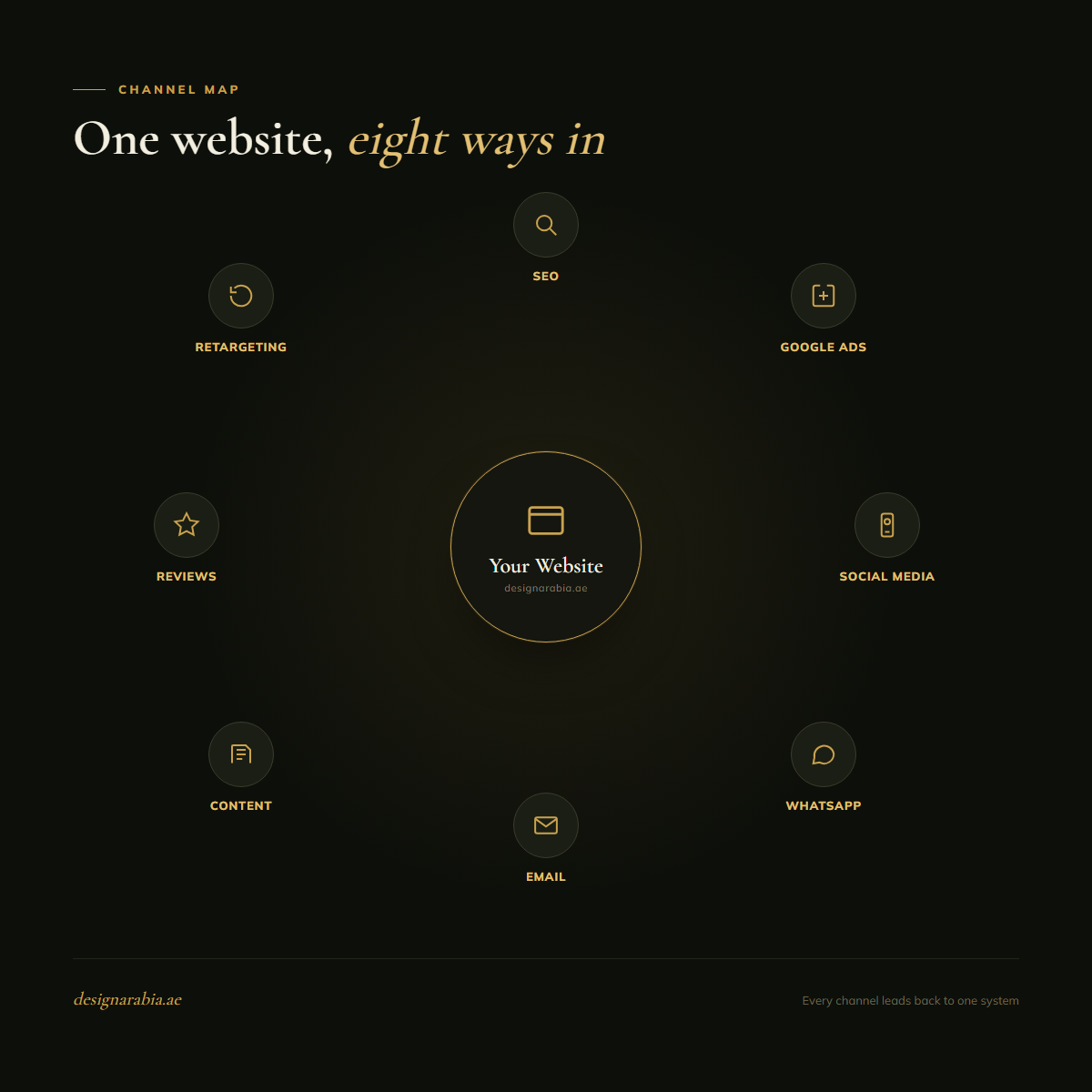
The important point is that digital marketing is not one single activity. It is a system. Your website, search visibility, social media, paid ads, content, customer data, and follow-up process all work together to move people from awareness to action.
Why digital marketing matters for UAE businesses
The UAE is a highly connected, mobile-first market. According to DataReportal’s Digital 2026 UAE report, there were 12.5 million active social media user identities in the UAE in October 2025, showing how deeply social platforms are woven into daily online behaviour. User identities can include duplicates and do not equal unique individuals, but the figure still highlights why social media strategy is central for many local brands.
For a business in Dubai, Abu Dhabi, Sharjah, Ajman, Ras Al Khaimah, Fujairah, or Umm Al Quwain, digital marketing matters because customers often research before they contact you. They may search in English or Arabic, compare prices, read Google reviews, check Instagram highlights, ask for recommendations in WhatsApp groups, or watch TikTok and YouTube content before making a decision.
Digital marketing helps UAE businesses:
- Be found at the moment of intent. Search marketing allows you to appear when someone is actively looking for your service.
- Build trust before a sales conversation. Reviews, case studies, videos, and helpful content reduce uncertainty.
- Reach specific audiences. Paid platforms can target by location, interests, language, behaviour, and other signals.
- Communicate in multiple languages. Many UAE businesses benefit from English and Arabic content, and some also create messaging for Hindi, Urdu, Tagalog, Russian, Chinese, or other audience segments.
- Measure performance. You can track website visits, enquiries, calls, purchases, ad spend, and conversion rates.
- Improve over time. Campaigns can be adjusted based on what is actually working.
In a competitive market, being online is not enough. A business needs a clear message, a useful website, a consistent brand presence, and campaigns that lead people toward a next step.
How digital marketing is different from traditional marketing
Traditional marketing includes channels such as print ads, flyers, billboards, radio, television, direct mail, and event sponsorships. These can still be useful, especially for brand visibility. However, they often make it harder to know exactly who saw the message, how they responded, and whether the spend produced sales.
Digital marketing is different because it is more trackable and flexible. You can see how many people clicked an ad, which page they visited, what form they completed, what keyword they searched, and which audience segment converted best. You can also pause, edit, or scale campaigns quickly.
For example, if a UAE home maintenance company runs a billboard campaign, it may receive more calls, but it can be difficult to prove which calls came from that billboard. If the same company runs Google Ads with call tracking and a dedicated landing page, it can see which keywords produced enquiries, how much each lead cost, and which service areas performed best.
That does not mean digital marketing is always better than traditional marketing. The strongest brands often combine both. A retail store might use mall signage, influencer collaborations, Google Maps visibility, Instagram content, and email offers together. The best channel depends on the audience, budget, goal, and buying journey.
The main goals of digital marketing
Before choosing platforms, every business should understand what it wants digital marketing to achieve. Different goals require different strategies.
Common digital marketing goals include:
Brand awareness
This is about making more people aware of your business. Awareness campaigns are useful for new brands, product launches, hospitality businesses, events, and companies entering a new emirate or customer segment.
Typical awareness channels include social media content, video ads, influencer marketing, display ads, PR, and educational content.
Lead generation
Lead generation means encouraging potential customers to share their contact details or start a conversation. This is common for clinics, real estate agencies, schools, consultants, B2B services, gyms, and high-ticket purchases.
Typical lead generation tools include landing pages, contact forms, WhatsApp buttons, downloadable guides, search ads, LinkedIn campaigns, and retargeting.
Online sales
For ecommerce businesses, the goal is direct revenue. This includes product page visits, add-to-cart actions, checkout completion, repeat purchases, and average order value.
Typical ecommerce channels include SEO, Google Shopping, Meta ads, TikTok ads, email marketing, SMS, influencer content, marketplace listings, and conversion rate optimisation.
Customer retention
Retention focuses on keeping existing customers engaged. It is usually more cost-effective to encourage repeat business than to constantly acquire new customers.
Retention tactics include loyalty campaigns, email newsletters, WhatsApp updates, exclusive offers, remarketing, customer education, and post-purchase support.
Reputation and trust
In the UAE, online reputation can heavily influence decisions. Customers often look at Google reviews, social media comments, testimonials, before-and-after content, and how professionally a business responds to enquiries.
Reputation-focused digital marketing includes review generation, community management, customer service content, founder-led content, case studies, and transparent FAQs.
Core digital marketing channels explained
Digital marketing includes many channels, but beginners should start by understanding the most important ones and how they work together.
Search engine optimisation
Search engine optimisation, or SEO, is the process of improving your website so it can appear more prominently in unpaid search results. When someone searches for your service, SEO helps your pages become easier for search engines and users to understand.
SEO includes:
- Keyword research
- Website structure
- Page titles and descriptions
- Helpful website content
- Local landing pages
- Internal links
- Website speed
- Mobile usability
- Backlinks from credible websites
- Google Business Profile optimisation
For UAE businesses, local SEO is especially important. A customer may search for “salon near me,” “accounting firm in Dubai,” “Arabic restaurant Abu Dhabi,” or “AC repair Sharjah.” If your website and local listings are well optimised, you have a better chance of appearing when people are ready to act.
SEO is not instant. It usually takes time to build authority and improve rankings. However, it can become a powerful long-term source of traffic and leads because you are reaching people who are already looking for what you offer.
Pay-per-click advertising
Pay-per-click advertising, often called PPC, means paying to show ads on platforms such as Google, Bing, Meta, TikTok, LinkedIn, Snapchat, or YouTube. In many PPC campaigns, you pay when someone clicks your ad, though some campaigns charge based on impressions, views, or other actions.
PPC is useful because it can generate visibility quickly. A new business may not yet rank on Google organically, but it can run search ads for high-intent keywords. A new ecommerce brand can test Meta or TikTok ads to see which products and creatives attract buyers.
The strength of PPC is control. You can choose your budget, audience, location, keywords, schedule, and creative. The risk is wasted spend if campaigns are not structured properly. A campaign with weak targeting, unclear landing pages, or poor follow-up can spend money without producing profitable results.
Good PPC depends on:
- Clear campaign objectives
- Relevant keywords or audiences
- Strong ad copy and creative
- Dedicated landing pages
- Conversion tracking
- Regular testing and optimisation
- A realistic budget
- Fast lead response
Social media marketing
Social media marketing uses platforms such as Instagram, Facebook, TikTok, LinkedIn, Snapchat, YouTube, and X to build attention, trust, and interaction. For many businesses, social media is where customers first experience the brand’s personality.
A strong social strategy should reflect how people in the local market actually discover, compare, message, and buy. For example, restaurants may rely heavily on visual content and influencer visits, while B2B firms may focus more on LinkedIn thought leadership, educational carousels, and case studies.
Social media marketing can include:
- Organic posts
- Short-form videos
- Stories and live sessions
- Paid social ads
- Influencer collaborations
- Community management
- Customer support replies
- User-generated content
- Social commerce features
The biggest mistake beginners make is treating social media as a notice board. Posting offers every day is not a strategy. Better social media content answers customer questions, shows proof, demonstrates expertise, entertains where appropriate, and guides people toward a clear action.
For UAE brands, cultural awareness is important. Visuals, language, humour, religious occasions, national events, modesty expectations, and audience diversity should all be considered. Content that works in one market may need adaptation before it is suitable for UAE audiences.
Content marketing
Content marketing is the creation of useful, relevant content that helps people solve problems or make decisions. Instead of only saying “buy from us,” content marketing earns attention by being helpful.
Examples include:
- Blog articles
- Buying guides
- FAQs
- Videos
- Webinars
- Downloadable checklists
- Case studies
- Email newsletters
- Infographics
- Product explainers
- Customer stories
A business setup consultancy might publish a guide to choosing the right licence type. A clinic might create videos answering common treatment questions. A real estate company might explain freehold areas, payment plans, and handover timelines in simple language.
Content marketing supports SEO, social media, email marketing, and sales. A useful article can rank on Google, be shared on LinkedIn, become a short video script, and help sales teams answer repeated questions. Good copywriting is what makes that content actually persuasive rather than just present.
Email marketing
Email marketing uses email to communicate with prospects and customers. It is especially useful for nurturing leads, promoting offers, educating subscribers, and encouraging repeat purchases.
A good email strategy is based on permission and relevance. Instead of sending the same message to everyone, businesses can segment audiences. For example, an ecommerce store can send different campaigns to first-time buyers, loyal customers, abandoned-cart users, and people interested in specific product categories.
Email marketing can include:
- Welcome sequences
- Newsletters
- Product recommendations
- Event invitations
- Lead nurturing campaigns
- Re-engagement emails
- Post-purchase education
- Review requests
The key is to provide value, not just promotions. If every email is a discount, customers may stop paying attention. If emails help them make better decisions, learn something useful, or access timely offers, they are more likely to remain engaged.
SMS and WhatsApp marketing
SMS and WhatsApp are important communication channels for many UAE businesses, especially where customers expect fast replies. They can be effective for appointment reminders, order updates, limited offers, lead follow-up, and customer support.
However, businesses should handle messaging carefully. The UAE Government portal notes that the Personal Data Protection Law provides a framework for protecting personal data, and it also references consumer protection rules that prohibit suppliers from using consumer data for marketing in certain circumstances. TDRA also maintains policies related to marketing SMS and unsolicited electronic communications. Businesses should use permission-based messaging, provide clear opt-out options where required, and seek qualified advice for compliance-sensitive campaigns.
From a marketing perspective, SMS and WhatsApp work best when they are timely and useful. A customer who booked an appointment may appreciate a reminder. A person who abandoned an enquiry may welcome a helpful follow-up. But repeated unsolicited messages can damage trust and harm the brand.
Website and landing page optimisation
Your website is often the centre of your digital marketing system. Ads, social posts, Google searches, directory listings, and emails often send people to your website or landing page.
A good website should answer three questions quickly:
- What do you offer?
- Why should someone trust you?
- What should they do next?
For UAE businesses, a website should also work well on mobile devices, load quickly, include clear contact options, and make it easy to call, WhatsApp, book, enquire, or buy. If your campaigns bring traffic but the website is slow, confusing, or missing key information, you may lose customers before they contact you.
Landing pages are focused pages created for specific campaigns. For example, a clinic might have one landing page for dental implants and another for orthodontics. A real estate company might build separate pages for each project. A training provider might create a dedicated page for a course.
Strong landing pages usually include:
- A clear headline
- A short explanation of the offer
- Benefits and proof points
- Images or videos
- Testimonials or reviews
- Frequently asked questions
- A simple form or contact button
- A visible call to action
Conversion rate optimisation
Conversion rate optimisation, or CRO, means improving your website or campaign experience so more visitors take the desired action. That action may be submitting a form, calling, booking a consultation, buying a product, or starting a WhatsApp chat.
CRO is important because more traffic does not always mean more revenue. If 1,000 people visit your page and only 5 enquire, the problem may not be traffic. It may be unclear messaging, weak proof, slow loading, poor mobile design, or a form that asks for too much information. A website redesign is sometimes the fastest way to fix this when the underlying structure is the real problem.
CRO improvements can include:
- Making the call to action more visible
- Shortening enquiry forms
- Adding trust signals
- Improving page speed
- Clarifying pricing or next steps
- Adding FAQs
- Testing different headlines
- Showing relevant testimonials
- Making mobile navigation easier
For many businesses, improving conversion rates can increase results without increasing ad spend.
Online reputation management
Online reputation management is the process of monitoring and improving how people perceive your business online. This includes reviews, ratings, comments, testimonials, news mentions, social conversations, and search results.
In the UAE, where customers often compare options quickly, reputation can be a major decision factor. A business with recent positive reviews, professional replies, real customer photos, and clear information may feel safer than a competitor with no reviews or unanswered complaints.
Reputation management includes:
- Asking satisfied customers for reviews
- Responding politely to feedback
- Addressing complaints quickly
- Updating business profiles
- Publishing customer success stories
- Monitoring brand mentions
- Training staff on digital customer service
The goal is not to hide every negative comment. The goal is to show that your business listens, responds, and takes customer experience seriously.
Analytics and tracking
Analytics is what makes digital marketing measurable. Without tracking, a business may know that it is posting, advertising, and receiving enquiries, but it may not know which activities produce profitable results.
Useful digital marketing metrics include:
- Website sessions
- Traffic sources
- Keyword rankings
- Click-through rate
- Cost per click
- Cost per lead
- Conversion rate
- Form submissions
- Phone calls
- WhatsApp clicks
- Add-to-cart actions
- Purchases
- Revenue
- Return on ad spend
- Customer lifetime value
Beginners should avoid tracking too many numbers without context. The best metrics are the ones connected to business goals. A restaurant may care about bookings and delivery orders. A B2B company may care about qualified leads. An ecommerce store may care about revenue and repeat purchases.
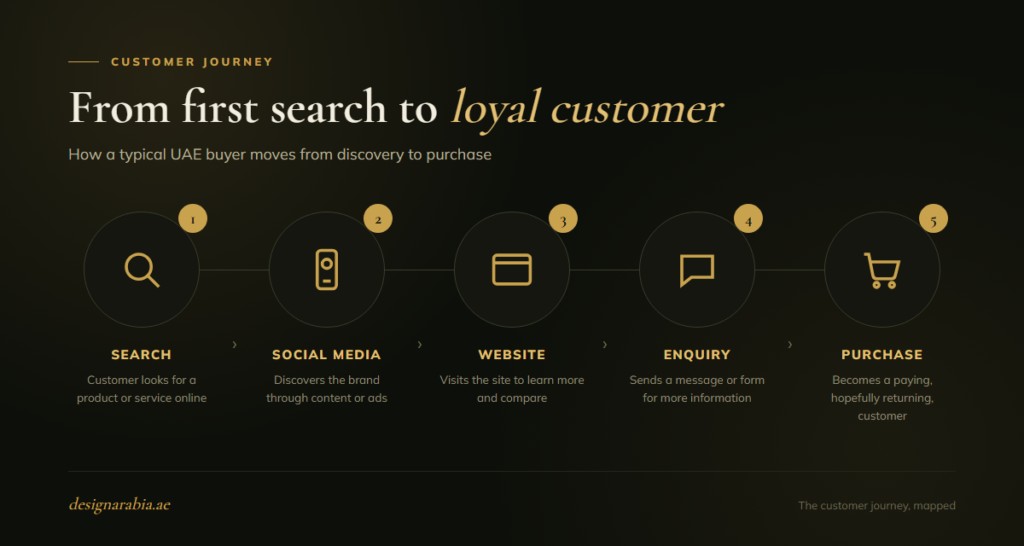
How digital marketing works as a customer journey
Digital marketing is easier to understand when you think of it as a journey rather than separate channels.
A potential customer may move through these stages:
Awareness
The customer first becomes aware of a problem, need, product, or brand. They may see a social media post, watch a video, hear about a business from a friend, or notice an ad.
At this stage, the content should be clear, memorable, and relevant. The customer may not be ready to buy yet.
Interest
The customer wants to learn more. They may visit your website, check your Instagram profile, read reviews, compare services, or search for related questions.
At this stage, educational content, FAQs, videos, testimonials, and helpful landing pages are valuable.
Consideration
The customer compares options. They may look at pricing, packages, locations, credentials, before-and-after examples, delivery times, or consultation availability.
At this stage, trust signals matter. Case studies, reviews, guarantees, clear processes, and transparent communication can make a difference.
Conversion
The customer takes action. This may be a purchase, booking, form submission, phone call, WhatsApp message, or store visit.
At this stage, the process should be simple. Do not make people search for the contact button, wait too long for a reply, or fill out unnecessary fields.
Retention
After the first purchase or enquiry, the business continues the relationship. Follow-up messages, loyalty offers, useful content, and good customer service can encourage repeat business.
Retention is where many businesses increase profitability. A customer who already trusts you is often easier to convert again.
Digital marketing strategy for beginners
A digital marketing strategy is a plan that connects your business goals to the right audience, message, channels, budget, and measurement system.
Here is a simple way for UAE businesses to start.
1. Define your business goal
Be specific. “Get more customers” is too broad. Better goals include:
- Generate 50 qualified leads per month
- Increase ecommerce revenue by 20 percent
- Improve appointment bookings for a specific service
- Grow brand awareness in Abu Dhabi
- Increase repeat purchases from existing customers
- Rank on Google for local service keywords
A clear goal helps you choose the right channel and measure success.
2. Understand your audience
Your audience is not “everyone in the UAE.” Define who you are trying to reach.
Consider:
- Emirate or neighbourhood
- Age range
- Language preference
- Income level
- Job role
- Pain points
- Buying motivation
- Decision timeline
- Preferred communication channel
- Cultural expectations
For example, a luxury clinic in Dubai Marina may need a different message from a budget-friendly clinic in Sharjah. A B2B software provider targeting finance leaders will need a different strategy from a cafe targeting tourists and residents.
3. Clarify your offer
Your offer should be easy to understand. If people cannot quickly see what you do and why it matters, they may leave.
Ask:
- What problem do we solve?
- What makes us different?
- Why should customers trust us?
- What proof can we show?
- What is the next step?
A strong offer does not always mean a discount. It could be a free consultation, fast delivery, expert guidance, flexible payment, premium service, convenient location, or a specialised solution.
4. Choose the right channels
Do not try to be everywhere at once. Choose channels based on where your audience spends time and how they make decisions.
A beginner-friendly channel mix might look like this:
- SEO and Google Business Profile for local discovery
- Google Ads for high-intent enquiries
- Instagram or TikTok for visual awareness
- LinkedIn for B2B authority
- Email for nurturing and retention
- WhatsApp for fast enquiry handling
- Retargeting ads to re-engage visitors
The best channel is not the one that is popular. It is the one that helps your audience move closer to buying.
5. Create useful content
Content should support the customer journey. Instead of posting randomly, create content for awareness, education, comparison, and conversion.
Examples include:
- “How to choose” guides
- Common mistake posts
- Customer success stories
- Behind-the-scenes videos
- Product demonstrations
- Service explainers
- FAQs
- Before-and-after examples
- Founder or expert insights
- Seasonal campaigns
For UAE businesses, content should also consider local context. Ramadan, Eid, UAE National Day, summer travel, school calendars, tourism seasons, and major events may influence customer behaviour, depending on the industry.
6. Build trust signals
Customers need reasons to believe you. Trust signals reduce risk and help people feel confident.
Useful trust signals include:
- Customer reviews
- Testimonials
- Case studies
- Certifications
- Awards
- Media mentions
- Clear contact details
- Real team photos
- Transparent processes
- Secure payment options
- Return or refund information where applicable
Trust is especially important for high-value services, healthcare, education, real estate, finance-related services, and any purchase where the customer feels risk.
7. Track performance
Set up tracking before spending heavily on campaigns. At minimum, businesses should understand where leads or sales are coming from.
You may need to track:
- Website form submissions
- Calls from ads
- WhatsApp clicks
- Online purchases
- Newsletter signups
- Booking confirmations
- Campaign source
- Cost per lead
- Lead quality
Tracking does not need to be perfect on day one, but it should be good enough to guide decisions.
8. Improve consistently
Digital marketing is not a one-time setup. It needs regular improvement.
Review:
- Which ads get clicks but no leads?
- Which pages attract traffic but do not convert?
- Which keywords bring qualified enquiries?
- Which social posts create saves, shares, comments, or messages?
- Which leads become customers?
- Which campaigns produce profitable revenue?
Small improvements compound over time. Better headlines, clearer offers, faster replies, stronger visuals, and improved landing pages can all increase results.
Social media in the UAE: what beginners should know
Because social platforms are so visible, many business owners assume digital marketing means posting on Instagram. Social media is important, but it is only one part of the bigger system.
A strong social media strategy should answer these questions:
- Which platforms does our audience actually use?
- What type of content builds trust in our category?
- Are customers looking for entertainment, education, proof, offers, or direct messaging?
- Should we create content in English, Arabic, or both?
- Do we need influencers, paid ads, organic content, or all three?
- How will social engagement become enquiries or sales?
Influencer and creator activity also requires care. The UAE Media Council states that an Advertiser Permit is required for individuals who engage in advertising activities on social media platforms, whether compensated or not, and its FAQ notes that individuals are prohibited from advertising brands, products, services, or events in the UAE without the relevant permit. Businesses working with creators should check current requirements and confirm that partners meet applicable rules.
From a practical perspective, social media should not exist separately from the rest of your marketing. A person who sees a Reel may check your profile, click your website, read reviews, and message you on WhatsApp. If any part of that journey is weak, attention may not become revenue.
Common digital marketing mistakes
Beginners often waste time and budget because they focus on activity instead of strategy. Here are common mistakes to avoid.
Trying every platform at once
It is better to do a few channels well than to post everywhere with no consistency or measurement.
Running ads without a strong landing page
If the page does not explain the offer clearly, ad traffic may not convert.
Ignoring mobile users
Many customers browse, compare, and enquire on mobile. A poor mobile experience can reduce conversions.
Posting without a customer journey
Likes and views are not enough. Content should guide people toward trust, enquiry, purchase, or retention.
Not responding quickly
In many UAE sectors, customers contact multiple businesses at once. Slow replies can lose leads to faster competitors.
Focusing only on new customers
Retention, referrals, reviews, and repeat purchases can be major growth drivers.
Not tracking lead quality
A campaign may generate cheap leads that never become customers. Quality matters more than volume.
Copying competitors blindly
Competitors may have different budgets, audiences, offers, or goals. Use competitor research for insight, not imitation.
A beginner checklist for UAE businesses
If you are starting from scratch, use this simple checklist:
- Define one primary business goal.
- Identify your most important customer segment.
- Clarify your offer and call to action.
- Make sure your website is mobile-friendly and easy to contact.
- Set up or improve your Google Business Profile if you serve local customers.
- Choose one or two priority social platforms.
- Create helpful content that answers real customer questions.
- Collect and respond to reviews.
- Test paid ads only when your landing page and tracking are ready.
- Use permission-based email, SMS, or WhatsApp follow-up.
- Review results every month.
- Improve based on data, not assumptions.
This approach keeps digital marketing manageable. You do not need to master every tool immediately. You need a clear foundation and a habit of continuous improvement.
How much should a business invest in digital marketing?
There is no single correct budget. The right investment depends on your industry, competition, revenue model, profit margins, goals, and internal resources.
A small local service business may begin with website improvements, local SEO, Google Business Profile optimisation, basic social content, and a modest search ads budget. A competitive real estate, healthcare, ecommerce, or education brand may need a larger monthly investment across content, paid media, creative production, analytics, and conversion optimisation.
When planning budget, consider:
- Website and landing page development
- Content creation
- Photography and video
- SEO work
- Paid media spend
- Campaign management
- Email or CRM tools
- Tracking and analytics
- Creative testing
- Community management
The more important question is not “How little can we spend?” It is “What level of investment gives us enough data and visibility to make smart decisions?” A very small budget in a competitive market may not produce meaningful results, while a larger budget without strategy can still be wasted.
Is digital marketing suitable for every business?
Almost every business can benefit from digital marketing, but not every business needs the same strategy.
A neighbourhood cafe may need local SEO, Instagram content, delivery platform visibility, reviews, and seasonal offers. A law firm may need authority-building content, search visibility, and professional LinkedIn presence. A fashion ecommerce brand may rely more on social video, paid ads, influencer content, email flows, and retargeting. A B2B supplier may prioritise SEO, LinkedIn, downloadable guides, and sales nurture campaigns.
The right digital marketing plan depends on how your customers make decisions. If they search before buying, SEO and PPC may be important. If they need inspiration, social and video may matter more. If the buying cycle is long, email and retargeting can help. If trust is a barrier, reviews and case studies are essential.
The future of digital marketing for UAE businesses
Digital marketing continues to evolve. Search behaviour is changing, social platforms are becoming more commerce-focused, artificial intelligence is shaping content and advertising workflows, and customers expect faster, more personalised experiences.
For UAE businesses, the fundamentals will remain important:
- Understand the customer
- Build a trustworthy brand
- Create useful content
- Make the buying journey simple
- Respect privacy and platform rules
- Measure what matters
- Improve consistently
Tools will change, but strategy remains the difference between random activity and real growth.
Final thoughts
So, what is digital marketing in practical business terms? It is the process of using online channels to help the right people discover your brand, trust your offer, and take action.
For UAE businesses, digital marketing can support visibility, enquiries, sales, loyalty, and reputation. But it works best when it is planned as a connected system rather than a collection of disconnected posts and ads.
Start with your customer, not the platform. Define the goal, clarify the offer, choose the right channels, create helpful content, track the results, and keep improving. That is the foundation of digital marketing that can grow with your business.
Key topics: digital marketing UAE, digital marketing strategy, SEO services UAE, social media marketing UAE, Google Ads UAE, email marketing UAE.