
You pay for a click, someone lands on your website, and then they wander off. It happens to almost every business that advertises online, and in most cases the problem is not the ad. It is where the ad sends people.
A landing page fixes that. This guide explains what a landing page is, how it differs from your homepage, the types you can build, what makes one convert, and the mistakes that quietly waste ad spend in the UAE market.
What is a landing page?
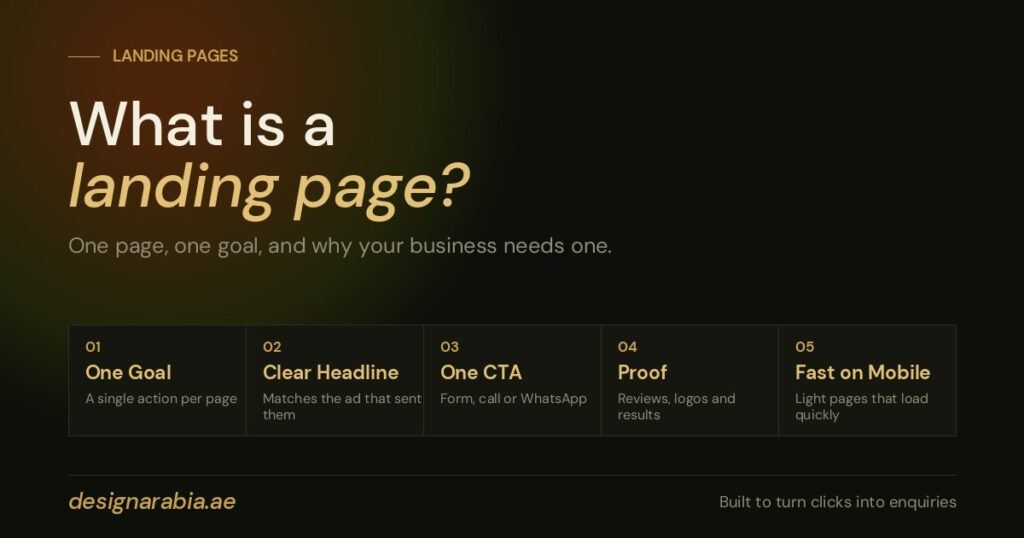
A landing page is a standalone web page built for one specific goal, usually tied to a campaign. It might be to collect an enquiry, book a consultation, sell a product or register someone for an event. Visitors arrive from an ad, an email, a social post or a search result, and the page is designed to move them toward a single action.
Most landing pages share the same core parts:
- A headline that matches what the visitor just clicked
- Short copy explaining the benefit and who it is for
- One clear call to action, such as a form, a phone call or a WhatsApp button
- Proof that you can be trusted, such as reviews, client logos or results
How a landing page differs from a homepage
Your homepage has to serve everyone: new visitors, customers, job seekers, suppliers. So it carries a full menu, many links and several messages. That is right for a homepage, and wrong for a campaign.
A landing page does the opposite. It removes options so people can focus.
- Goal: a landing page has one. A homepage has many.
- Content: a landing page speaks to one offer and one audience. A homepage gives a broad overview.
- Navigation: a landing page usually hides the main menu. A homepage shows it in full.
Neither replaces the other. Your website tells people who you are, and a landing page asks them to take one specific step.
Why your business needs one
Higher conversion rates
When there is one message and one action, fewer visitors get distracted. That usually means more enquiries or sales from the same traffic.
Better use of ad spend
If you run Google or Meta campaigns, a page that closely matches the ad makes the click more valuable. A relevant landing page also supports ad quality on platforms like Google Ads, which can influence what you pay per click. Our Google Ads management and Meta Ads services always start with where the traffic will land.
Results you can measure
Because each page has one goal, you can see exactly what works. You can track conversion rate, cost per lead and drop-off, then test a new headline or button and compare.
Faster campaign launches
A dedicated page lets you launch a Ramadan offer, a property launch or a new service without touching your main site. It also keeps campaigns easy to compare.
Types of landing pages
- Lead generation pages collect contact details through a short form, often in exchange for something useful such as a quote, a guide or a consultation. Keep the form to the fields you truly need.
- Click-through pages warm visitors up before a purchase. They explain the product or service in more detail and then send people on to the cart or booking page.
- Sales pages aim to close the sale directly. They are often longer, because they need to answer objections, show proof and make the offer clear.
- Event and webinar pages promote a date, time and speaker, and collect registrations.
- Squeeze and splash pages are short pages built to capture an email address or share a brief announcement before sending people elsewhere.
What makes a landing page convert
A headline that matches the click
Visitors decide in seconds whether they are in the right place. The headline should repeat the promise of the ad or link they clicked and speak to the problem they have. If your ad says “Free website audit”, the page should say that too, not “Welcome to our company”.
Content that is short and easy to scan
Use plain language, short paragraphs and bullet points. Use images that support the message, not decoration that slows the page down.
One clear call to action
Tell people exactly what to do with a specific verb, such as “Get my free quote” or “Book a call”. Make the button stand out and repeat it further down a longer page. In the UAE, many customers prefer to message rather than fill in a form, so a WhatsApp button next to the form often lifts enquiries.
Proof that builds trust
Show real client reviews, recognisable logos, certifications, results and the number of businesses you have helped, but only where it is true and you can back it up. A phone number, a business address and a clear privacy note also reassure visitors who have never heard of you.
Speed and mobile design
Most UAE visitors will arrive on a phone, so the page must load quickly and be easy to use with a thumb. Compress images, avoid heavy scripts and test on a real device, not just a desktop browser.
Arabic and English where it matters
If your audience includes Arabic speakers, a properly built right-to-left Arabic version of the page is far more convincing than machine-translated text. Match the language of the page to the language of the ad.
How to plan your first landing page
- Define one goal. Decide what a successful visit looks like, for example a submitted form, a booked call or a purchase, and how you will measure it.
- Know your audience. Think about who clicks, what they want and what might stop them. Different audiences usually deserve different pages.
- Craft the offer. Make it specific and valuable to that audience. A clear offer with a real reason to act now beats a vague promise.
- Write the content. Start with the headline, then a few benefit-led points, proof and the call to action.
- Design a clean page. Use plenty of white space, strong contrast on the button and a layout that works on mobile first.
- Launch, measure and test. Track conversions from day one, then improve with A/B tests.
If you would rather have an expert handle it, our landing page design service covers the strategy, copy, design and tracking.
Testing and improving your page
A landing page is never finished. A/B testing lets you compare two versions that differ in one element, such as the headline, the button text or the form length, and keep the one that performs better. Change one thing at a time, wait for enough traffic to trust the result, and use analytics to watch conversion rate, bounce rate and time on page. Small, steady improvements add up over a campaign.
Common landing page mistakes
- Sending ad traffic to the homepage. It splits attention and loses visitors.
- Unclear messaging. If people cannot tell what you offer within a few seconds, they leave.
- Too many options. Extra links and competing buttons dilute the main call to action.
- Slow or poor mobile experience. This is one of the most common reasons for wasted ad spend.
- Long forms. Every extra field costs you some enquiries.
- No tracking. Without it you cannot tell what is working.
Frequently asked questions
What is a landing page?
It is a standalone page built for one goal, such as collecting leads or making a sale, and designed to convert visitors from a specific campaign.
How is it different from a homepage?
A homepage serves many audiences and goals. A landing page focuses on one offer and one action, with fewer distractions.
Do I need a landing page if I already have a website?
If you run paid ads, email campaigns or promotions, yes. A page built for the campaign almost always converts better than a general page on your site.
What should a landing page include?
A matching headline, concise benefit-led content, a clear call to action, proof, and a fast, mobile-friendly design.
Final thoughts
Landing pages turn paid and campaign traffic into enquiries, bookings and sales, and they give you clean data to improve with. Start with one goal, one audience and one action, and build from there. For practical patterns you can adapt, see our guide to landing page examples that actually convert. If you would like help creating pages that convert for the UAE market, you can request a free quote.