
An online store is more than a catalogue on a webpage. It is your salesperson, your brand and your revenue engine running around the clock. If the site is slow, confusing or falls over during a Ramadan or White Friday sale, customers simply leave and buy from a competitor.
That makes choosing an e-commerce website development company one of the most important decisions you will make for the business. The right partner builds a store that is secure, scalable and ready for how people actually shop in the UAE. This guide walks through what to look for, what to ask, and which warning signs to take seriously.
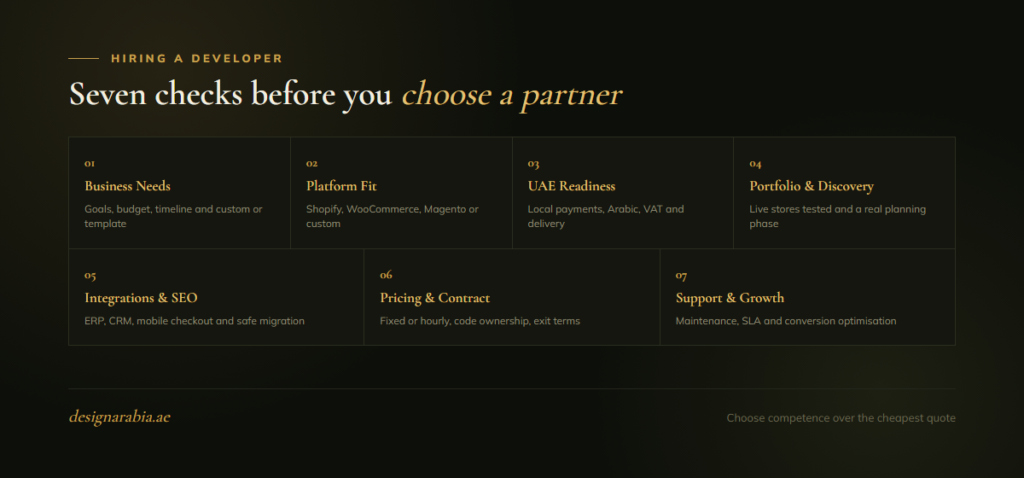
1. Start With Your Business Needs
Before you speak to a single agency, get clear on your objectives, timeline, product range and budget. That clarity becomes the brief every agency quotes against, which is the only way to compare them fairly.
In-house team or an agency
An in-house team gives you direct control and instant communication, but the overhead is heavy: salaries, visas, benefits, software and training. An agency gives you a ready-made team of designers, developers, testers and project managers. For most growing UAE brands, outsourcing is the more cost-effective route, with an internal owner managing the relationship.
Custom build or template
Templates suit startups that need to launch quickly on a tight budget. As the business grows they can become restrictive. Custom development gives you a distinct brand experience and a back end built around your inventory and sales process, at a higher cost and longer timeline. Our guide to what a website costs in Dubai shows how each route affects the budget.
2. Match the Platform to Your Store
A good agency recommends a platform based on your catalogue size, whether you sell B2C or B2B, and your budget, not on whichever one they happen to prefer.
- Shopify and Shopify Plus: quick to launch, easy to manage and backed by a large app ecosystem. Watch monthly fees and app costs as you grow.
- WooCommerce: a strong fit for content-led brands already running on WordPress, with high flexibility. Our WordPress development team builds on it regularly.
- Magento (Adobe Commerce): suited to large catalogues and complex multi-store setups, with heavier development and hosting needs.
- Custom or headless: for unusual workflows or high-scale requirements, with the highest cost and ongoing technical support.
Judge technical depth by the questions they ask you, not the logos on their site. A team that only installs plugins will struggle the moment you need something custom. Ask about their experience with APIs, performance tuning, headless commerce and how they manage the database as the catalogue grows.
3. Check They Are Ready for the UAE Market
This is where generic agencies and UAE-experienced ones part ways. A store that works in another market can quietly fail here if the basics are missing.
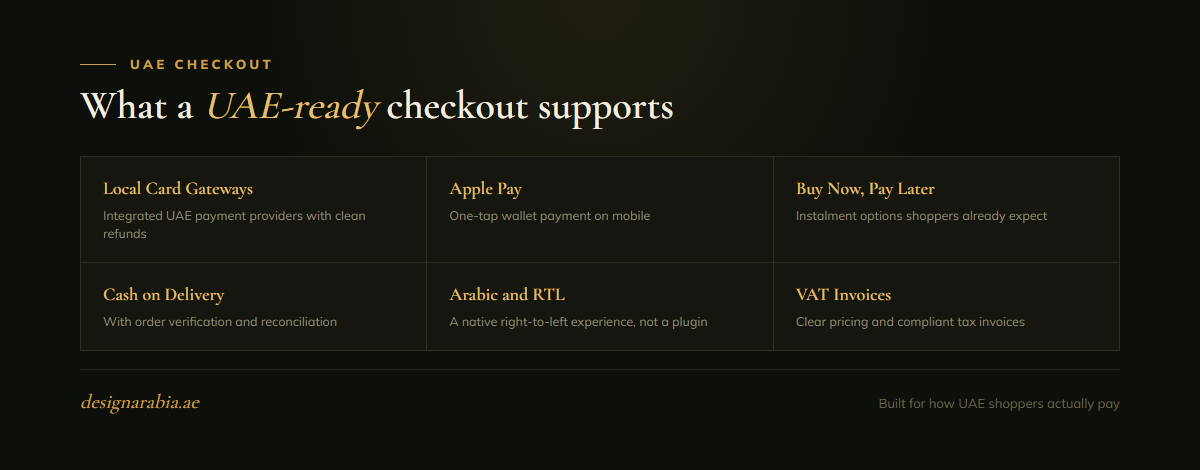
- Local payment gateways. Ask which UAE gateways they have integrated before, such as Telr, PayTabs, Network International or Checkout.com, and how they handle failed payments and refunds.
- Wallets and buy now pay later. Apple Pay and instalment options such as Tabby and Tamara are now part of many shoppers’ expectations at checkout.
- Cash on delivery. Still widely used in the region, and it needs proper order verification and reconciliation to avoid failed deliveries.
- Arabic and right-to-left support. Not a plugin afterthought. Menus, filters, forms and checkout must feel natural in Arabic, which affects design and testing time.
- VAT and invoicing. UAE VAT is 5% on most goods, so the store should produce compliant tax invoices and display prices clearly.
- Delivery integrations. Live shipping rates, tracking and returns through the couriers you actually use, such as Aramex or Emirates Post.
- WhatsApp. Click-to-chat and order updates over WhatsApp matter in this market and should be planned, not bolted on.
Licensing is a separate question. Selling online in the UAE needs a trade licence that covers e-commerce activity, and that advice should come from the relevant authority or a business setup adviser, not your developer.
4. Vet Portfolios and Insist on Discovery
How to read a portfolio
Never take an agency at its word. Their past work is the best predictor of yours. Look beyond attractive homepages and test the live stores they have built: is the navigation intuitive, how fast does it load on a phone, and is the checkout smooth? Look for experience in your niche too. A team that has only built industrial B2B catalogues may not understand a fashion or beauty shopper.
Why the discovery phase matters
Be wary of any agency that wants to start building on day one. A proper discovery phase covers buyer personas, customer journeys, wireframes and prototypes, and the technical architecture and data flows. It is the best protection against scope creep, blown budgets and missed deadlines, and it is far cheaper to fix a wireframe than a finished build.
5. Check Integrations, Mobile Experience and SEO Protection
Integrations
Your store has to talk to inventory software, your CRM, accounting tools and marketing platforms. Integrating payment gateways and ERP systems is among the most complex parts of any build, so ask for specific examples of systems they have connected before.
Mobile-first, not just responsive
Most online shopping now happens on phones. Mobile-first means thumb-friendly tap targets, a short and forgiving checkout, saved details and wallet payments, not simply a layout that shrinks. Ask to see their stores on a real phone, on a normal mobile connection.
Migrations and SEO
If you are replatforming an existing store, you risk losing the search rankings you have earned. A careless migration creates broken links and a sharp drop in organic traffic. A competent agency maps 301 redirects, preserves metadata and canonical tags, and monitors Google Search Console after launch. Ask for their migration checklist before you sign.
6. Understand Pricing, Contracts and Red Flags
Common pricing models
- Fixed price: best when the scope is well defined. You know the cost upfront, but new features mid-project usually trigger change orders.
- Time and materials: best for complex, evolving projects. You pay for hours worked and gain flexibility, but need to manage the budget actively.
Be cautious of instant, cheap quotes that come without understanding your requirements. If you are comparing quotes, see our guide on what to look for in a website quote.
Questions to ask before you hire
- Who owns the code and intellectual property after launch? The answer should be you.
- Who will be my day-to-day contact, and is there a dedicated project manager?
- How do you handle QA and testing, especially checkout and payments?
- What happens if the project runs past the agreed deadline?
- Which UAE payment gateways, couriers and Arabic builds have you delivered?
Red flags
- Poor communication: slow replies, or jargon used to confuse you during the sales process.
- No post-launch plan: handing over the keys and disappearing is not a partnership.
- Unrealistic timelines: a complex custom platform promised in three weeks is a warning sign. Good development takes time.
- No clear ownership terms for the domain, hosting, code and licences.
7. Plan for Support and Growth After Launch
Launching is the starting line, not the finish. Stores need regular security patches, plugin updates, backups and bug fixes. Ask what support packages are offered and whether a service level agreement is available, so that if the site goes down during a major sale you have a team committed to fixing it quickly.
Once the store is stable, focus shifts to growth. Look for an agency that can run conversion rate optimisation: A/B testing, heatmaps and session recordings to find where shoppers drop off. As the business scales, a retainer or dedicated developer arrangement lets you keep building features and expanding into new markets without restarting the search for a partner. Our e-commerce website development service is structured around that long-term relationship.
Final Thoughts
Choosing an e-commerce developer takes patience and a clear view of your own goals. Aim for the most competent, communicative and UAE-aware partner, not the cheapest one. Check their platform expertise, test their portfolio, insist on a discovery phase, confirm they handle local payments and Arabic properly, and make sure there is real support after launch. Take your time, ask the hard questions, and choose a team that is as invested in your store’s growth as you are. If you would like to talk through your project, you can request a free quote.