
A strong brand identity is the foundation of every successful UAE business. It shapes how customers recognise, trust and remember your company before they ever request a quote.
Your brand identity is everything customers see, hear and feel when interacting with your UAE business, from your logo and colours to your tone of voice, website experience, proposals, social media templates and customer communication.
The UAE market is uniquely challenging because your brand needs to resonate with Emirati nationals, Arab expatriates, Asian expatriates and Western expatriates, each with different languages, expectations and cultural references. That is why a professional brand identity UAE strategy needs more than a nice logo.
Why brand identity matters for UAE businesses
Customers in Sharjah, Dubai, Abu Dhabi and the wider GCC often compare multiple companies before making contact. A consistent brand identity helps your business look established, trustworthy and easier to remember across Google search, Instagram, LinkedIn, WhatsApp, signage and printed material.
Strong branding also improves marketing performance. When your visuals, message and offer feel consistent, people are more likely to recognise your ads, stay on your website, engage with social content and return when they are ready to buy.
Start with clear brand positioning
Before logo design begins, define what your brand should stand for. A UAE company should be clear about who it serves, what problem it solves, what makes it different and what kind of experience customers should expect.
- Define your target audience by city, sector, language and buying intent.
- Clarify whether the brand should feel premium, friendly, corporate, technical, creative or local.
- Document the main services, proof points and trust signals customers need to see.
- Decide how Arabic and English content should work together across the brand.
Build a bilingual Arabic and English logo system
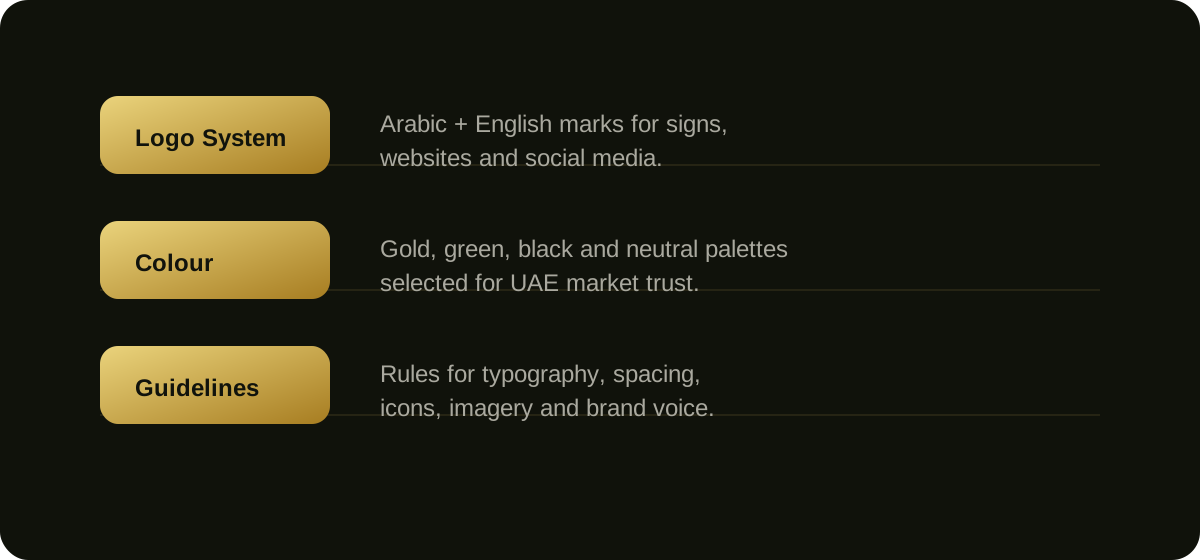
The most impactful decision for UAE brand identity is whether to invest in a bilingual Arabic and English logo and brand system. Businesses with professionally crafted Arabic logo variations often connect more naturally with Arabic-speaking customers and government-adjacent audiences.
A good bilingual logo system should include horizontal, stacked, icon-only and simplified versions. It should work on social media profile images, websites, uniforms, packaging, signboards, proposal covers and WhatsApp profile images without losing clarity.
Choose colours with cultural context
Colour plays a critical role in brand identity UAE projects. Green can communicate growth, prosperity and regional familiarity. Gold can suggest quality, heritage and premium value. Blue often communicates trust and reliability. Neutral palettes can feel refined and professional when used with care.
The right palette depends on your category. A clinic, real estate company, restaurant, ecommerce brand and B2B consultancy should not all use the same colours. Your colour system should support recognition and readability across both light and dark backgrounds.
Select typography that works in both languages
Arabic typography is not only a translation detail. Arabic calligraphy style and typeface selection communicate personality. Naskh-inspired styles can improve readability, while more decorative Arabic lettering can feel elegant and premium when used correctly.
For English, choose fonts that match your market position and remain readable on mobile screens. Your Arabic and English type systems should feel related, even when they are not the same font family.
Create brand guidelines for consistent marketing
Brand guidelines turn design into a practical business system. They help your team, designers, social media agency and developers use your identity correctly across every touchpoint.
- Logo spacing, minimum sizes and incorrect usage examples.
- Primary, secondary and accent colour values for web and print.
- Arabic and English typography rules.
- Icon style, photography direction and graphic patterns.
- Social media templates, presentation layouts and ad creative rules.
- Brand voice guidance for English and Arabic communication.
Use your identity consistently online
A strong identity should appear consistently on your website, landing pages, SEO content, Google Business Profile, Instagram posts, LinkedIn graphics, email signatures and proposals. This consistency helps people connect repeated impressions with the same company.
For SEO and AI search, consistent branding also supports entity recognition. Your company name, logo, services, location, licence information, social profiles and contact details should match across your website and trusted external platforms.
When should you refresh your brand identity?
You may need a brand refresh if your current logo looks outdated, does not work on mobile, has no Arabic version, feels inconsistent across platforms or no longer matches the quality of your services. A refresh can modernise the brand without losing existing recognition.
How Design Arabia builds UAE brand identities
Design Arabia creates brand identities for UAE businesses that work beautifully in both Arabic and English, from initial logo concepts through complete brand guidelines, social media templates and website-ready assets.
As a licensed digital marketing agency in Sharjah, UAE, we design brand systems that are not only visually polished but practical for SEO, social media, advertising, website development and long-term growth.
Ready to build a stronger UAE brand?
If your company needs logo design, Arabic branding, brand guidelines or a complete visual identity system, start with a focused brand audit and a clear positioning brief.
Key topics: brand identity UAE, logo design UAE, Arabic logo design, brand guidelines UAE, graphic design UAE.